About a week and a half ago, I decided to lay out
some wild bird seed on my back deck (in two seed trays I bought at
the hardware store), just to see if I could attract any songbirds at
all. I don't have any trees in my backyard or really anywhere close
for that matter, as I don't live in the typical urban neighborhood
with big tall trees and neighbors close by with a small backyard. I
figured that since I have a huge, open backyard with my neighbors
spaced out that it might be more difficult to attract songbirds. It
took about a week before I noticed the first bird feeding off the
seed I laid out on the deck. I went with the seed tray on the deck
rail route because I don't have a squirrel problem around my house
(for the reasons I mentioned above -- no trees!). I wasn't sure
which species was visiting my feeding station because every time I
got a glimpse of the bird, it would take off. The deck rail is
actually quite close to my back porch door.
So when I got off work this morning, I got the
brilliant idea to set up the camera (Nikon D3) on a tripod (I have
to use my 80-400mm lens, because the distance from my back door to
the seed trays is less than the minimum focusing distance of the
600mm lens!) and put it in interval timer shooting mode. This is
the first time I've tried this to try to capture the birds, so I
pre-focused the D3 on one of the seed trays and used 80mm focal
length so I could get a better idea of the bird behavior around the
seed tray. I set it up to start at 8:20am, firing every 20 seconds
for 200 total shots. This would span a little over an hour's time.
Once I got it all set up, I went to bed (I just got off my 10pm to
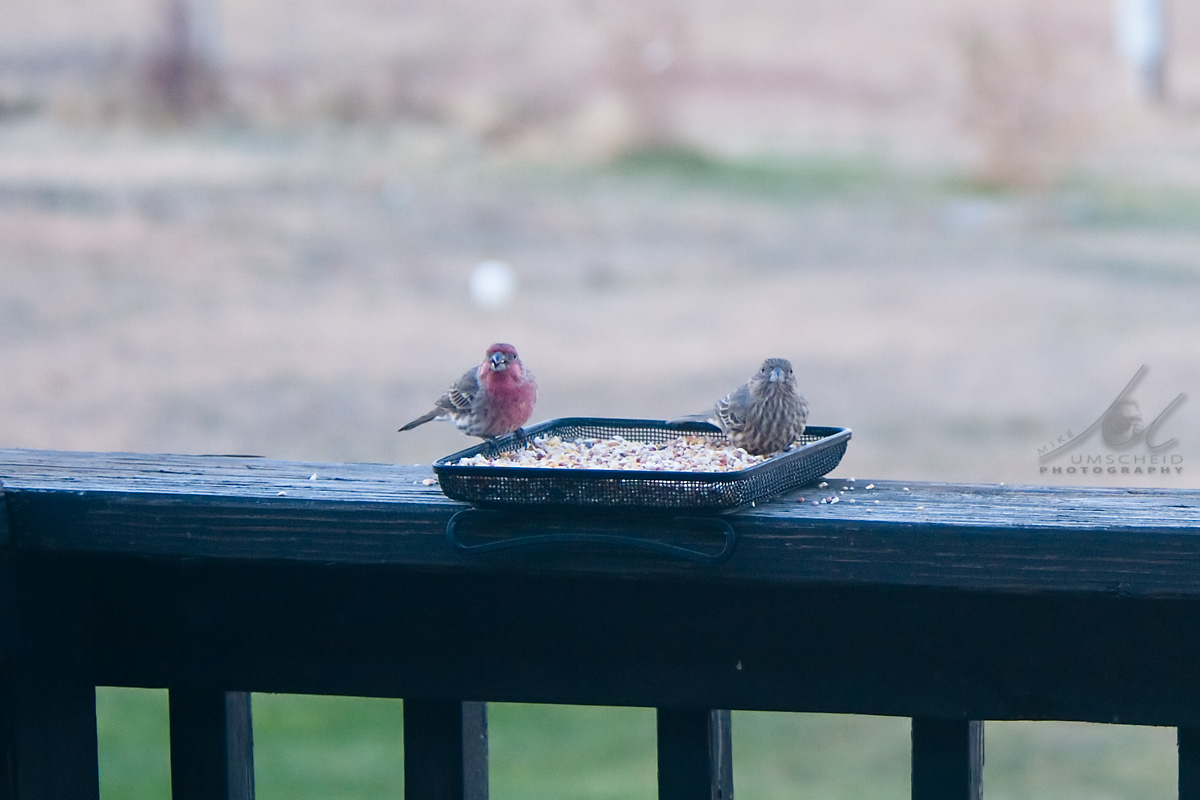
6am mid shift). When I woke up I took a look at the images, and I
was very pleasantly surprised to see two House Finches -- one male
and one female.
Now that this next step was a success, it was time
to move on to the next step, which was to create landing perches for
the birds above the seed trays so I could photograph the birds
without having evidence of feeders in the shot. I went to the
hardware store and bought some additional supplies to accomplish
this, as well as perusing the local creek to find some dead fall
branches to set up above the feed. So now the next minor goal is to
get a good zoomed in shot of one of the finches, or other common
backyard song bird, perched on one of the branches I set up above
the seed trays. I will try to perfect this setup over the next
couple of months during the winter season. My ultimate long-term
goal is to create a songbird photography setup in my backyard (where
I had my vegetable garden the past two seasons) and get some amazing
bird images with the 600mm lens.
Now that I have a Nikon 600mm f/4 lens, I am
interested in expanding my nature photographic interests to include
songbirds. There are several reasons for this. One -- I don't have
to drive nearly as far to areas to photograph birds. Two --
songbird photography is extremely difficult, and I love a good
challenge. It's not just photographing the bird and trying to get
the sharpest image possible, but you have to take into account other
elements of an image to make it truly a good image. I have a LOT to
learn. Three -- this also allows me an excellent opportunity to
become more familiar and comfortable handling such a heavy and
intimidating lens. Repetition and practice in long lens technique
(both on the tripod AND handheld) is crucial to attaining the best
images. I did say handheld. Yes, using the 600mm f/4 is possible,
I've found. I have the Vibration Reduction (VR) version of this
lens, as well as using a camera, Nikon D3, that allows higher ISO
yet still very clean images so I can maintain a higher shutter speed
even at the focal length AND reduced light in the woods.
Ford County State Park, only 5 miles from my
house, has a fairly nice wooded area with dirt trails south of the
small lake and is a perfect local place to photograph songbirds in
their natural environment. Unfortunately since fall migration has
passed, only wintering birds are around to photograph, and there
aren't a lot of them around. Yesterday (October 31), I went on my
first small hike with the 600mm using the carry strap that came with
the lens, and I hiked with the lens without a tripod. I think there
is an advantage to doing this, because I like to be able to enjoy a
hike even if there aren't any subjects to photograph, and if an
opportunity arises, I can set up quickly without having to lug the
tripod around. Plus, the hike is a little more enjoyable while
carrying less. Granted, I probably won't be making this a regular
practice, and will probably only hike with a 600mm lens at Ford
County State Park since it's so close to home, but at the same time,
it does open up the gamut of things to shoot with the "quick draw"
mindset while on a hike .
Okay enough rambling. Very early in the hike
yesterday, a pair of Dark-eyed Juncos were perched close to ground
level on some small branches about 20 feet away next to the trail.
Fortunately, the birds were close to ground level so I could steady
the lens on my knee as I sat to shoot. I focused on the nearest
bird and after achieving initial camera focus with auto-focus, I
turned AF off and just tweaked focus with the huge focus ring. I
love the enormous focus ring on the 600mm. Despite the heavy
cropping, I was very pleased with how sharp the bird came out.
Attached to this post are the three best images from this shoot.
That was my only good opportunity on the 40 or so minute hike this
day.