High Plains Drifter


disclaimer:  "The meteorological views/forecast thinking expressed are those solely of the author of this blog
and do not necessarily represent those of official National Weather Service forecast products,
therefore read and enjoy at your own risk and edification!"

April 25, 2007

Chase Acct: April 20 (Texas Panhandle)

Filed under: Chase Accounts,Storm Chasing — Mike U @ 3:56 pm

Magnifcent LP Supercell after sunset with a cresent moon and Venus in the pristine evening sky.  Location is near Happy, TX(Times in CDT) (photo links in bold)  As I mentioned in my morning forecast post on April 20th, I had quite a tough decision to make regarding a chase target area.  I ultimately optioned for the southern target in the Texas Panhandle based solely on gut intuition.  I just liked the higher CAPE farther south and dryline convergence by late afternoon/early evening, and I knew that if something went up, it would be isolated… perfect for storm photography.

I  departed Dodge City around noon heading south for a target in the east-central Texas Panhandle — around Stinnett, TX.  I kept a good cell data signal all the way to the target area, and I arrived in Spearman around 2:30.  I hung around town here for about a half hour, as it appeared the dryline was really beginning to sharpen-up to my west around Dumas.  I kept my options open, as the best moisture was still just to the southeast of Amarillo with mid to upper 50s dewpoints.  I figured this moisture would continue to advect northwestward to Amarillo and points north of there to where the best convergence appeared to be setting up.  With this thinking in mind, I cheated more west closer to the convergence and I could see some initial small clumping cumulus developing to my west near and north of Dumas.  Other cumulus was developing to the south of me farther away, near the Palo Duro Canyon area.  I sat at this location between Cactus and Spearman for probably a half hour just waiting — figuring I was in a good spot.  As time went on, the cumulus to my west was just not doing anything, and better clumping cumulus was occurring to my south — so I continued south and east to Stinnett, where I sat and waited again for about 20-30 minutes about 5 miled west of town after I refueled and grabbed a bite to eat in town.  By 5pm, I was watching several areas of potential interest for initiation, and ultimately spotted hard towering cu developing well to my west-southwest near Vega, TX.  This was some 90 miles to my southwest.  There was nothing going on at my latitude… so southwest I went.  By the time I reached Hwy 87 at Four Way, the hard towers that prompted my heading this direction…completely evaporated into nothing.  This was frustrating!  I hit a complete low point on this chase right here.  It was after 6pm, and I was getting tired of driving seemingly aimlessly across the Texas Panhandle.  What made things even more frustrating was that storms were now developing way to my south…about 120 miles away to the west of Plainview.  I was so ticked off at this point, I just about said to hell with it and headed back home…   but after looping the radar of these newly developed storms and seeing that they were moving more northly…essentially towards my direction… I decided not to give up.  This was a very good decision.

So south I go once again.  All of this was reminding me very much of my May 9, 2006 chase when I was caught too far north — taking a nearly identical route to get to developing storms well off to my south.  I reached Amarillo and headed east a bit on Hwy 287 before heading back south again, in anticipation of the developing storms being east of I-27 by the time I got down there.  As it turned out, the first storms that developed weakened significantly with new storms developing back west of the interstate again.  D’oh!  Now I am thinking I’m going to be caught too far east because of this move!  Oh well.  At Claude, I continued south, taking me through the Palo Duro Canyon (where I lost my cell data signal).  At 7:45pm or so, it was getting pretty late, so I had to really motor to get south of this storm before good light would wane.  I never did get down there before sunset and here’s why:  Remember those first storms I talked about that diminished as they moved east of the interstate?  Well, they left some incredible skyscape views with picturesque virga showers amidst the terrain.  After driving through the canyon, I decided I need to get a photo of these remnant virga showers/orphan anvils during the photographer’s "golden hour" at sunset with the canyon landscape — thus after driving south, I turned around on Hwy 207 and went back north a few miles through the canyon.  I’m glad I did.

As the sun got lower on the horizon, the old orphan anvil with remnant virga lit up in beautiful hues of violet, pink, and orange.  The rugged terrain of the canyon landscape also became a brilliant hue of deep, burnt orange and red.  Here are a few vertical landscape photos (1 | 2 | 3 | 4 | 5) showing the wonderful colors of the canyon landscape as well as the decaying storm’s leftover virga shower.  Not a single other chaser was around, not even another car passed by this entire time I photographed here.  It is a moment in storm chasing/photography I will absolutely cherish.  I think it takes extreme luck and/or a lot of hard work to get these kind of beautiful skyscapes amidst such colorful and dynamic landscape.  In my case, I consider it work, because I tried for these images after I realized the potential I had about 30 minutes prior (prompting me to turn around and go back into the canyon when other chasers would try to get out of the canyon as quick as they could!  The fine-art photography love I have has certainly changed the way I chase storms.

The 10 or 15 minute window I had with these colors in the canyon had come…and gone.  But I forever have it captured in photography.  After that, I was completely thrilled with the outcome of my chase — no supercell, no tornado, yet very successful from a photography standpoint.  I could have left and gone back home happy with just that 10-15 minutes during the "golden hour".  Little did I know what I had in store for me after sunset:

With my interest in long-exposure photography, I decided that even though the sun had set, I still had enough light for the next hour or so for some interesting shots, should the storms to my immediate southwest hold together.  I turned around and headed back south on Hwy 207…then west towards the storm near Happy at around 8:30pm. Here is a look at the storm at around 8:50pm looking west.  I then found a spot along Ranch #1075 along the county line of Randall and Swisher about 5 miles east of Happy.  From this spot, I sat and photographed one of the most amazing LP supercell updrafts I’ve photographed to date.  Against the clear twilight sky, this storm, while small, stood tall...and the periodic intracloud lightning illuminated structure just enough to highlight the beauty of this storm.  The lightning illumination is what made these images so striking.  I had my Nikon D200 set up in full manual mode at about 4sec exposure and f/3.5 aperture… although this aperture was too wide open/fast for the brightest lightning within this updraft… but at the same time, I had to have a fast aperture to mitigate motion blur of the storm itself.  It was a fine balancing act between aperture and ISO sensitivity to keep shutter speed at 6 seconds or less.  The motion blur of the storm was too much if I kept the shutter open longer than about 6 seconds.  But it just kept getting better:

Before I knew it, Venus was making an appearance to the left of the southern edge of the updraft and followed soon by the crescent moon amidst the semi transparent southern edge anvil of this LP storm.  I simply couldn’t believe what I was witnessing/photographing!  LP supercell, Venus, and the crescent moon all in one shot!!  1 | 2 | 3 | 4  Some clouds from the south were invading and the moon and Venus would eventually become hidden once again.  As darkness was winning out, I had to increase my ISO to about 640 in order to keep a shutter speed at 6 seconds or less.  The storm base was perfect with a lowered area and an inflow tail on the south side.  The updraft base area was becoming more laminar in appearance due to a more stable surface layer, and after about this time, the light was getting too low for any reasonable photos under a 6 second exposure.  Shortly after this time, I called it a chase and began my trek back north towards Dodge City.  From a pure photography standpoint, this was definitely one of the top 3 or 4 chases since I began digital SLR photography in 2005.

Photo Gallery:

http://www.underthemeso.com/gallery2/stormchase/chase07/2007apr20/

Mike Umscheid


April 8, 2007

Chase Acct: March 24 (Southeast CO to KS-NE Border)

Filed under: Chase Accounts,Storm Chasing — Mike U @ 9:58 am

A severe storm with organized structure north of Oberlin, KS(times in CDT). (bold links are photos)  Well, as fun as the day before’s chase was, this chase was equally frustrating.   I began the morning in Sterling, CO — after staying the night with Tony and his friends in a fairly nice Best Western suite.  I awoke around 8am or so and noticed after looking at a few things that there might be a really interesting play near the center of the ejecting upper low over southeastern or east central Colorado.  I figured storms (with perhaps a "cold-core" tornado threat?) would get going shortly after noon or so, and I figured I needed to get down perhaps as far south as Lamar-Eads.  So I parted ways with Tony and his group and drove south.  I should note that one of the big reasons why I decided to head towards the center of the upper low/cold pocket aloft was that east of this area… in southwestern Nebraska and western Kansas…the atmosphere was completely hosed from a pretty large overnight MCS, which really impacted potential instability for the afternoon.  Both the NAM and RUC models suggested much lower CAPE (instability) in these areas, which was the primary area of interest a few days out.

So I headed south to I-70 and continued south to Eads.  Per radar, there was already showery activity developing along the Front Range, which would only continue to develop eastward through the day.  Most of my interest was along an eastward extending arm of showers moving over the Raton Mesa area east and northeast of Trinidad.  The RUC and NAM were both indicating a small area of enhanced low level CAPE by early afternoon north of the Lamar-La Junta area at the nose of a developing thermal ridge.  There was also an axis of horizontal wind shear at the surface (source of vertical vorticity) north of La Junta which would aid in any weak tornado development.  These were the things running through my mind as to why I should consider chasing this area (while no one else really did).  As I approached Eads, I monitored newly developed storms to my southwest.  I filled up gas in Eads and headed southwest from there to kind of get in this area.  There was a little bit of heating (per visible satellite) between this stuff and the other showers farther southwest.  By 1:30pm, There were two areas of interest on radar, one northwest of Ordway and the other just south of La Junta, as I continued southwest on CO96. 

The storm near Ordway was moving northwest and was more difficult to reach than the other storm near La Junta.  The storm northwest of Ordway had a suspicious, very low cloud base that I could barely see on the horizon.  I really wish I was closer, because at times, I was seeing some interesting lowerings and possibly a funnel.  I never did get any photos though.  Eventually, I went north a few miles north of Ordway and positioned myself between the two areas of activity, but there just wasn’t a whole lot of structure to these storms… and in fact the southern storms were taking on more of an outflow dominant type structure.  So, I gave this area a try, and it didn’t "perform", so back east I went to get in position of more isolated storms.  A somewhat interesting small storm developed on the southeast tail of this action to the southwest of Haswell, and I busted east and northeast to get ahead of it.  I did stop for a little bit to get a few photos (1 and 2), but this storm never really developed anymore than what was photographed here, so in anticipation of further development of storms to the northeast as the dry intrusion worked northeast… it was time to keep on driving north.

Driving, and driving, and driving was the story of this chase.  As you can see from the radar and GPS images, all I was doing was driving for the most part during much of the late afternoon and early evening…from Eads, Colorado to Oakley, KS and eventually up to east of McCook, NE.  All the storms were visually displeasing from a photographic standpoint, so I didn’t take any photos at all during this stretch until I approached Nebraska.  I drove north from Oakley in hopes the storms to my west would develop into something interesting, but it would really never happen.  Meahwhile, 40 miles east of where I started the day in Sterling, there were at least a couple weak, brief tornadoes that were documented by Al Pietrycha.  That didn’t exactly make me happy… but oh well, what can you do.  I finally made it far enough north to photograph some decent storm structure just prior to crossing into Nebraska north of Oberlin, KS (1 and 2).  This would be about it though.  To top off this "wonderful" chase, listening to the KU basketball game vs. UCLA was just pouring salt on an open wound.  I made it as far northeast as here before I took a break and turned around to head back home.  After I got a bite to eat in Oberlin I headed home.  I did stop once though to photograph distant lightning in the Cb to the north which was kind of fun.  Photos of lightning illuminated Cbs:  1 | 2 | 3 | 4

Photo Gallery:

http://www.underthemeso.com/gallery2/stormchase/chase07/2007mar24/

Mike Umscheid


April 7, 2007

Chase Acct: March 23 (Northeast CO)

Filed under: Chase Accounts,Storm Chasing — Mike U @ 10:01 pm

Severe storm with some supercell structure looking west towards Fort Morgan, CO(times in MDT). (bold links are photos).  This was a pretty fun chase.  I decided to chase Northeast Colorado since it looked like moist upslope flow would help sustain organized storms in this area by early to mid evening.  I left Dodge City during the late morning hours and arrived in Limon around 1:30pm.  There were already some weak storms going up over the geographically favored area of the Palmer Divide near Monument.  After some food and a fill-up, I continued northwest to Agate where I headed west on unpaved roads to get a little closer to this area of developing storms along the "urban corridor".  The storms took their time developing, and I sat at this location west of Agate for upwards of an hour.  Finally, as the activity was moving more to the northeast, a weak storm became more organized, and I continued west then north after this.  I stopped for a little bit to photograph the marginal structure of this storm, but it did reveal a picturesque precipitation shaft (2) to the west.  On approach to I-70, the storm was becoming a bit less interesting structurally, and the radar signature was also on the demise it had appeared.  I continued southeast to Deer Trail where I met up with Tony Laubach and his chase friends.  We sat there in Deer Trail watching trashy looking storms to out west and north.  We struggled for a bit as to what our next move would be, but ultimately decided to head north and east after newly developed poor-looking storms.
So the chase was on… well sort of.  Around 6pm, we headed north from Last Chance to intercept the best-looking storms on radar near Wiggins.  At around 6:30pm, we reached Brush, and it was at this point that Tony (with his group) and I would diverge…as they were more interested in heading east towards better moisture, whereas I was more interested in the best looking storm closest to our location — which was the storm out near Wiggins.  There was indications that the storm to the west was getting just a bit better structure with an elongated "shelf-cloud" looking structure to the west-southwest.  I headed west on I-76 to get closer to this storm.  It didn’t take long to get in a decent position ahead of this developing storm, and I then headed south half-way between Fort Morgan and Brush.  I stopped at a location about a mile and a half south of the interstate and setup for some photography. 

The storm was really intensifying rapidly with vastly improved structure. (radar).  I did call Tony to let him know of what I was seeing and strongly suggesting they turn around and re-consider this storm.  They did. One thing to note was the dewpoint at Akron to the east… it had increased to 47°F after being in the upper 30s to near 40 most of the day.  The area where this storm was developing was finally seeing some better moisture just after sunset.  The storm revealed some well-organized structure with a faint horse-shoe updraft base.  I really liked the mid-level inflow bands developing in the inflow region of the storm.  As the storm was moving east, I decided to re-position myself to the northeast side of Brush.  A severe thunderstorm warning was issued and golfball size hail was reported on the north side of Fort Morgan.  Radar showed some supercell structure with a decent weak-echo region.  I reached my next stopping location for photos just northeast of Brush, and this is where I met back up with Tony and co.  It was a very nice looking fairly high-based storm.  (radar).  As darkness prevailed, the storm showed very nice striated banding structure, which was very photogenic along with the lightning.  Here are links to a few photos from this location:  1 | 2 | 3 | 4 | 5

The storm approached too close once again, and it was time to move northeast.   Unfortunately, in the process, the storm was weakening and was losing its structure.  I stopped briefly one more time for additional lightning photos, but there was too much rain to get out and setup for any shots.  Shortly thereafter, we called it a chase and headed northeast to Sterling for the night.  (radar)  This was my first real decent severe storm structure chase of 2007, and it was good to enjoy it with Tony and his friends! 

Photo Gallery:

http://www.underthemeso.com/gallery2/stormchase/chase07/2007mar23/

Mike Umscheid


November 3, 2006

Chase Acct: October 26 (Southwest KS) [part 2, "The Chase"]

Filed under: Chase Accounts,Oct 26, 2006,Special Cases,Storm Chasing — Mike U @ 11:48 pm

Looking to the south-southeast at a dusty tornado about 4 miles northeast of Minneola around 4:35pm CDT on Oct 26, 2006I departed Dodge City around 1:45pm or so, with the plan just to head south into the clearing area immediately south of the front so I could get a visual on things with respect to vertical Cu development.  Low clouds were parting around the Clark-Ford Co. line with the temperature reaching the lower 60s.  I made it as far south as the Hwy 160 junction just a few miles north of Big Basin… as the main band of convective looking clouds were pretty much right along this zone.  I had a temperature of about 66°F at this location around 2:30pm. Scanning the skies from west to above my through east… it didn’t appear obvious yet where the best focus along this boundary was, and with this in mind, I decided to sit back for a little bit.  I decided to call work (NWS-DDC) and let them know I was out, and provided them an observation since my current location happened to be one of the areas in our forecast area devoid of surface obs.  At 2:30pm, I had an east-southeast wind about 10 mph with 67°F.  If you look at a surface obs map at this time, you wouldn’t see any southeast winds…as there was only an extremely narrow corridor of east to southeast winds.  Perhaps 10 miles south of me, winds were probably out of the southwest with very dry dewpoints in the deeply mixed dry intrusion air stream. 

Fairly soft towering Cu dominated the sky in a NW to SE orientation along this front.  I was beginning to get itchy feet and decided to move.  There was a small base developing to my west… almost immediately overhead…as well as to my east-southeast, and all this stuff was slowly pivoting north.  I figured I needed to favor east a little bit, so I drove back north on 283 to 4 S Minneola, where I drove east on an unpaved farm road approaching Clark State Lake.  Driving north, then east to this new location, my temperature dropped to about 62°F with the wind out of the east-northeast…only 12 miles northeast from that previous location I was at.  I found a good vantage point here now, near Clark St. Lake, with small towers trying to get going all along the boundary to my west through southeast.  Through about 3:15pm or so, I still didn’t observe anything that prompted me to re-position myself… i.e. a significant, dark base with pronounced towering Cu growth… that is, until about maybe 3:20 or 3:25pm or so (estimation).  Off to my distant west-northwest, I could tell it was getting increasingly dark, and I saw the first hint of the best, sharpest Cu devleopment atop this darker mass to the northwest some 40 miles away.  It was at this point (with visions of 10 April 2005 running through my mind in terms of how things might "unzip" down the boundary beginning in the northwest first…then southeast later), that I decided to race back east to Hwy 283 to investigate this area, that appeared to be some 20 miles or so northwest of Minneola.  I passed through Minneola (for the 2nd time of the day) going back north.  Once I got out of Minneola heading north, I could certainly pick out what appeared to be a very impressive, long and dark updraft base looking WSW through NW.  There even appeared to be a lowering of the cloud base on the northern portion of this base.  I turned west on Wrangler Road, which is 3 miles north of the Ford-Clark County line (5 N Minneola).  The time was now around 3:40pm, and the weather radio alarmed for the first tornado warning.  The TOR was for that precise area where I was seeing this lowering to my distant west-northwest.  The chase is on now!!

The very elongated base was very promising…suggesting very significant updrafting over a pretty large corridor extending south of where the TOR was issued.  Continuing west, I kept my eye on the main area of interest to my northwest I had not even considered, however out of the corner of my eye, I see this thin "sheath" looking thing to my southwest.  Possibly a landspout tornado!  After watching this for about 15 seconds, I noticed a debris cloud beneath this feature confirming a weak tornadic circulation beneath this feature.  Time was about 3:50pm and I immediately called NWS DDC with a report.  I made it clear that this was farther south of where they were indicating possible tornado on radar and that it was farther south along the flank.  I turned south 1 mile on 101 Rd. then west again on X Rd in the far southwestern tip of Ford County…crossing into extreme southeastern Gray Co.  I stopped around 4:00pm at a location 1 mile west of county line with Ford and 2.5 miles north of county line with Meade.  I was directly underneath the flanking updraft.  I observed another dusty, weakly tornadic circulation to my southeast down the flanking line, but my main interest was still just immediately north of me.  The problem was, the main storm was now getting too close to the cool air, as my temperature was about 57°F, yet there was fairly modest cloud base rotation at various points from my immedate NNW to my immediate southeast.  I was probably not in the best location, as tornadogenesis could occur almost on top of me! 

I had to keep up with the storm, so I headed back east two miles, then north on 101 Rd. (back into Ford County now)… not even two miles north, the sky was eerily dark with impressive rotation just a mile up the road.  Cloud bases were also extremely low, making it tough to really see much structure.  After stopping a couple times to monitor this, I crawled north to stay with this rotation.  I continued about two miles more north before making the turn east as I was getting into more rain.  I drove one mile east in the rain, and decided I was too far north now.  I headed back south on 102 (Crooked Ck.) Rd.  It was at this point that I needed to stay south along the flanking towers, and stay away from this cold air.  The 3rd tornadic circulation I spotted now at 4:23pm to my southeast also confirmed this thinking :)   It was now "get south as quick as you can" mode.  Thankfully, the unpaved roads I was on were well-grated, so the rain didn’t make them extremely slippery.  I stopped briefly to photograph the distant, dusty tornado to my southeast then continued to drive south.  I called to report this tornado at around 4:25pm, and it dissipated while I was on the phone with the report.  I was at the intersection of Wrangler & 102 Rd. at this point, where I headed back to the east. 

About 5 miles later looking south-southeast, a higher contrast (being a bit closer) dusty vortex developed at 4:30pm.  I turned south on 108 Rd.  About 1.5 miles later, the tornado to my south-southeast developed an impressive black looking dust cloud.  Wow!  At this same time, I noticed tumbleweeds swirling right in front of me and to my right in the adjacent field about 50-100 yards away… Wow again!  Sensory-overload at this point with vorticity everywhere!  The tornado to the south was now getting closer, since I was driving towards it, and I stopped briefly to photograph close-in shots of the circulation at the ground.  I then turned east again on the County Line Rd. (Ford-Clark).  At this point, I am now about 4.5 miles northwest of Minneola.  After I turned east, I immediately stopped to photograph this beautiful, tall, dusty tornado churning away over baren farmland!!  Classic!  At various points, you could distinguish a faint condensation funnel above the intense ground level rotation/debris cloud.  Time was now 4:35pm and I photographed from this location for about 5 minutes as the tornado travelled northeast.  I used my 80-400mm lens exclusively at this location and got some interesting images of the base of this tornado with trucker traffic driving along Hwy 54 just on the other side of the tornado.  The tornado was 2 miles away and Hwy 54 was 3.  The circulation at ground level became indistinguishable around 4:40pm and I used that opportunity to keep driving east to stay with it.  I reached Hwy 283 now with the tornado to my southwest approaching me!  The tornado now redeveloped again with a classic, narrow condensation funnel about 1/3 of the way to the surface and a black, dusty debris cloud underneath… fantastic!  (zoom-in of debris cloud) Time 4:42pm… I was obviously watching the movement of this thing with extreme caution, since it was essentially coming towards me.  Needless to say, the car was running and I as shooting from right next to my passenger door!  I began to notice some right to left forward motion, so the tornado was going to miss me to the south.  The black debris cloud dissipated, but what was left was a sky full of tumbleweeds… a countless number of them!  I was close enough to the ground circulation, that with my 400mm lens, I could discern the very tight rotation in the tumbleweeds about 1/2 mile to my south-southwest.  The circulation was approaching Hwy 283 now to my south.  I set myself up to photograph the tornado crossing the road, anticipating the shot.  Fortunately (for the sakes of the shot), the tumbleweed debris remained intact as the circulation crossed the road.  A sherrif was on the opposite side of the tornado watching this event unfold.  The weak tornado crossed the road causing no damage to the powerlines, however a large quantity of tumbleweeds accumulated on the powerlines itself, marking where the tornado crossed. Time was now 4:48.

This tornado then ultimately dissipated in a farm field to my southeast, narrowly missing some farm structures.  Not to be outdone, a larger scale storm circulation was now crossing Hwy 283 to my *north*!!  A fairly large, "cigar" shaped funnel was now getting ready to cross the road, now keep in mind I’m in the same spot as where I was watching the southern tornado cross Hwy 283.  This weak tornado crossed the highway to my north at about 4:52pm.  It would be until several days later that I noticed a 2nd formidable funnel on the right hand side of one of my images, on the other side of Hwy 283.  This would match the LSR report of "2 tornadoes at the same time, one on either side of Highway 283", at about this exact time ~4:53pm.  I get ready to leave this location, but before so, another dusty tornado was evident to my southeast probably 5 miles away under one of the new developing towers.  I drove into Minneola (for the 3rd time), then head northeast on Hwy 54 a few minutes before 5:00pm.  When I got out of town and had a view again to the north, much to my surprise (or maybe not!), was yet another full-fledged tornado probably 3-4 miles away.  This tornado appeared visually to be the strongest one I saw this day… it had a narrow, but fully condensed condensation funnel in contact with the ground and certainly appeared to be associated with some larger scale tornado cyclone that evolved from some supercellular processes.  3 miles northeast of Minneola, I headed north to get closer to this area of interest.  This tornado was no longer visible as I was driving north as it appeared to become wrapped in rain/hail.  I drove north about 3.5 miles and noticed a significantly occluded "tornado cyclone" feature with a bit of a tip near the bottom of this feature… although it wasn’t in contact with the ground, there was likely some weakly tornadic circulation beneath it.  Time was now 5:05pm, and this feature was probably the remaining circulation from the full-condensation tornado I saw about 7 minutes prior.  This would be the last tornado I would see for the day. 

I drove south back to Hwy 54 and decided to keep chasing, heading northeast towards Bucklin.  I entered light rain and low clouds with about 53°F… yuck!  I then drove south on Hwy 34 to get back into the warm air.  Along the drive south on Hwy 34, I had a great view of the low-topped Cb structure of the storms to my northeast.  This storm produced a tornado north of Protection, however I never did see it, as it was too far away and I had hills blocking my view below the cloud base.  After photographing the Cbs, I headed to Hwy 160 then drove west through Ashland and began my trek backhome…which took me through Minneola for the 4th and final time of the day :)  

This was a fairly remarkable chase and was extra-special for being so close to home — one of the reasons I love it so much out here in Southwest Kansas!  This chase marks my 4th October tornado day, dating back to my first October tornado in 1998 in Yocemento, KS. 

Click for detailed map of events

Photo Gallery:

http://www.underthemeso.com/gallery2/stormchase/chase06/2006oct26/

Mike Umscheid


November 2, 2006

Chase Acct: October 26 (Southwest KS) [part 1, "The Forecast"]

Filed under: Chase Accounts,Oct 26, 2006,Special Cases,Storm Chasing — Mike U @ 2:36 am

Given the uniqueness of this tornado event, I am breaking this chase account into two parts, the forecast and then the chase itself, for the purpose of documenting all the decision making processes that went on leading to the success of this chase.  I will begin by stating that, yes, my geographical starting location (Dodge City) played a huge role in my decision to chase…being only 30 miles from the target area.  I was working a 9pm to 5am shift earlier that morning, preparing the Southwest Kansas forecast for the time period Oct 26-27th… so I had a very clear idea of the overall synoptic scale situation impacting my forecast area.  For brevity, I will not go into detail on the overall meteorology involved, but I would encourage you to read the Area Forecast Discussion (AFD) I wrote earlier that morning pertaining to the meteorology for October 26th SW Kansas forecast.  You will see me mention things like mid level potential vorticity (PV) and maximized potential instability in the 800-600mb layer at the nose of the mid level dry intrusion.  These are meteorological parameters unfamiliar to many storm chasers and amateur or new severe storms forecasters (mainly because they aren’t available on the internet) — yet are very key factors in many "cold-core" tornado events, I am beginning to find.  While I didn’t mention the possibility of tornadoes in my AFD, I mentioned the key things that seem to be very important for "cold-core" tornado events.  The reason I did not mention tornadoes in my AFD was the simple fact that the surface front appeard to be just too far south of my forecast area, and that any convection in my forecast area would be largely elevated above the shallow stable layer (but just barely).  This was based primarily on the high-resolution NAM model.  Intuition told me, however, that if the front arced back north at the nose of the dry intrusion/PV anomaly into SW Kansas, then insolation could really make things interesting with an enhanced tornado risk. 

At any rate, I got home at 5am and went to bed with absolutely no intention to storm chase, primarily because I had to work again later that evening at 9:00pm, which would restrict me to a very tight leash within an hour or two of Dodge City.  I woke up around 12:30 or so, and the first thing I did when I woke up was check out the weather, since I am always interested in seeing how my forecast is verifying in complicated weather situations like this one.  Much to my surprise, I was seeing the visible satellite image revealing sunshine over the southern counties from Hugoton east to Meade to near Ashland.  We were still in low stratus and drizzle in Dodge City with a northeast wind and 53°F.  See the visible satellite image below, at 1745z (12:45pm CDT):


1km visible satellite image at 1745 UTC on 26 October 2006.  The yellow oval indicates my chase target area after looking at this image and the 17z short-fuse composite.

I then looked at the 17z short-fuse composite and noticed a large surface moisture convergence bullseye over far southwest Kansas near the edge of the clearing on the visible satellite (see image below).  Also of important note was that the surface theta-e ridge was nosing westward immediately north of the OK state border south of Dodge City.  So, putting everything together from just these two charts told me everything I needed to know… the front was farther north and we could certainly be looking at more than just "small hail" that I had put in the forecast for this area earlier that morning at work!  To me, it was looking much more like a potentially tornadic situation after looking at just these two bits of information.  With nothing planned that day until I was due in to work again at 9pm that evening, I decided to give this a shot and head due south from Dodge City to investigate this convective environment.  I was seeing some similarities to 10 April 2005... as storms were developing near the Colorado border… and as the day progressed, storms kept "unzipping" southeast at the nose of the mid level dry intrusion.  When this "unzipping" hits the higher low level theta-e, then tornadic storms could be possible given the massive amounts of nearly stationary surface frontogenesis and vertical vorticity…not to mention enhanced horizontal streamwise vorticity (from 0-1km vertical wind shear) for tilting.  I kept re-creating in my mind how this might unfold a-la 10 April 2005.  I had my camera gear pretty much all packed and ready to go, as I usually do for impromptu situations just like this one.  Since I do not shoot video anymore while storm chasing, the only gear I had to assemble was my photography pack and my laptop computer for GPS navigation.  I didn’t even have my Alltel mobile internet setup going, since I can’t use it (my new Dell laptop does not have a PC card slot, but an ExpressCard slot, so I have to buy a USB adapter)… something I was going to address in the off-season.  I left Dodge City for the drive south around 1:45pm or so.  Chase account to be continued on next blog post…


The short-fuse composite (chart #1) that we are generating every hour at NWS-DDC.  The valid time of this chart is 17z on 26 October, which coincides pretty closely with the visible satellite image above.  Note the theta-e ridge nosing westward towards the maximum area of surface convergence.

July 15, 2006

Chase Acct: July 11 (Southwest KS)

Filed under: Chase Accounts,Storm Chasing — Mike U @ 1:13 pm

Marginal supercell updraft looking west near Ensign, KSWell this was about as impromptu of a chase as I’ve ever made… a day where I worked this particular event issuing severe weather warnings/statements during the early evening hours… followed by a short chase. I worked the day shift on the 11th, but I stayed over two hours until 6pm to help out with a severe thunderstorm watch in effect over our forecast area along with a few ongoing storms. At 6 o’clock, it was determined that the activity was isolated enough that my services were no longer necessary for overtime, so I went home. When I left to go home, there were a cluster of storms persisting over the Garden City area… and I could see these to the distant west. I didn’t think much of the storms as they were sub-severe at the time, and it did not cross my mind to go chase this storm given the lack of strong shear to support well-organized structures worthy of photographing. It certainly wasn’t a supercell…. at the time.When I got home I took a nap for about 45 minutes… waiting for the MLB All-Star game to start. I got up a few minutes after 7 and noticed Finney County to the west was under a severe thunderstorm warning. I pulled up a radar image and was surprised to see this storm had organized into a much healthier looking storm with supercell characteristics… an inflow notch and all! It was a quarter after 7pm and I was thinking about chasing. I think this would be the latest I had ever departed home for a daylight storm intercept! Sunset wasn’t until about 9:05pm, so I had plenty of daylight left to get to the storm and get some photography in…barring the storm held together.

I filled up the Jeep with gas in town and headed south out of Dodge. When I left, the storm was exiting the Garden City area moving south-southeast. I already had a great view of the updraft base of the storm from within the city limits. I had to get closer, of course, so I headed southwest on Hwy 56 a few miles to Road 107. I went south on the this dirt road until I got to Saddle Road where I continued west a few more miles. The storm revealed pretty good structure for the environment it was in with little in the way of wind shear. There was a band of 40-45 knots of flow in the upper troposphere around 250-200mb, and this seems to be critical for storm organization in the summer…whereas winds at all other levels were 15 knots or less. I would consider this storm a marginal supercell, as it did have some rotation to it, as evidence by the structure and organization, but it wasn’t really a full-fledged supercell producing golfball size hail or larger. Regardless, it was a beautiful little storm in a pristine atmosphere all by itself… perfect for photography! The storm bit the dust at sunset, but the remnant storm structure persisted long enough to get great, deeply saturated colors (1 2). Very rewarding for the total round trip of around 40 miles!

Photo Gallery >> http://www.underthemeso.com/gallery2/stormchase/chase06/2006jul11/

Mike Umscheid

June 21, 2006

Chase Acct: June 20 (Northeast CO)

Filed under: Chase Accounts,Storm Chasing — Mike U @ 12:03 pm

Updated on June 29 with full account including many photos:

On Tuesday 6/20, I wanted to take advantage of a day-off work to chase. As mentioned in the previous blog post, I liked the area in northeastern Colorado where post-frontal moist upslope flow was best…along the Cheyenne Ridge.

I left Dodge City around mid-morning, arriving in Oakley around 11am where I stopped at the library to refine my target. Keep in mind, I was chasing more “old school” this day… with no laptop computer… so I had to rely on my morning forecast and one or two updates until I got to my target. This gave me the opportunity to actually sit down and do a surface map analysis at 16z (see below).

At 16z (11am CDT), the surface winds in my target area were out of the north around 10 knots. Traditionally, this is what you do not want to see the late morning hours in your target area. The “rules” are a lot different on the high plains adjacent the Rockies, though. All the models clearly showed these winds veering around to the northeast then almost due east by 00z (7pm)… the prime time for photogenic storms. The low level moisture was very good for this region in the north surface winds, as you can see on the surface map… for those chasers/weather weenies/meteorologists who know how to read these :)

entry_20060629_1.jpg

I then stopped for lunch and another quick update at the NWS in Goodland. Everything appeared to be on track, so I continued my trek to the Akron-Sterling area. A couple of developing storms were visible to my distant northwest when I arrived in Yuma, with the most prominent storm about 80 miles to my north-northwest along the Cheyenne Ridge near Sidney. This was my initial target storm, so I set a course for the Sterling area…and then points north from there should the storm hold together. By the time I arrived in Sterling, the storm was not looking nearly as organized. Jay Antle was nowcasting for me and he advised of a storm well to the north near Scottsbluff/Alliance, NE. At the same time, other towering Cu were developing to my west. I headed northeast on I-76 about 20 miles to the Crook exit. I hung around at this interchange, monitoring the developing towering Cu field back to my west. Another call from Jay advised that the radar echoes aloft were really increasing in the New Raymer area…about 50 miles west of me. This activity was moving in my general direction… and by the time an anvil canopy was established… I backtracked southwest about 10 miles to the Proctor exit, where I re-fueled and began my chase.

At Proctor, I headed west a few miles on the county road grid…then south, south of the interstate towards the Fleming area. I had this view of the developing storm to my west at around 4:30pm MDT. The storm was still fairly disorganized with at least three areas of updraft development from west-southwest through northwest. About 4:50pm, 5 miles south of Fleming, the updraft base was looking more impressive (1 2 3), yet still pretty elongated. While this was going on, another storm was developing almost on top of me, just to my immediate southeast. I was beginning to get rained on and I had to move. I was discouraged by this new, weak storm near the inflow region of this storm. I drove east on a county road southeast of Fleming to stay ahead of the main storm to my northwest…but driving through light rain from the new weaker storm to my immediate east. While I was driving east, a tornado warning was issued for my storm behind me to the northwest for a reported tornado northeast of Sterling. Whether there was really a brief tornado or not, it had to have been spawned from the updraft base I was watching/photographing south of Fleming. There could have been a weak, brief “landspout” type tornado, but I’m a little suspect of the report.

In the meantime, the storm to my immediate east was getting better developed, but it was finally moving far enough east/northeast of me. The main storm back to my northwest was still holding its own, but things were about to change very rapidly. My location was about 6 miles southwest of Haxtun where I stopped briefly along a north-south paved county road. Matt Crowther, who was also providing me nowcast help, called me on the phone to give me a radar update. In a span of less than 5 minutes, my main storm to the northwest was rapidly evolving into a bonafide supercell storm. The updraft base became much more focused and taking on rotation, with a wall cloud to boot (1 2). The wall cloud attained some rotation, but at the same time, it was becoming undercut by outflow. Remember that weak storm to my immediate east? Well it had now merged with the main storm (vertical) and was taking on impressive structure. The storm was now evolving into an HP supercell with a ton of precip. This is a look to the north at the portion of the storm that was originally that weaker storm out ahead of the main storm.

All this precipitation the storm was generating was detrimental to the supercell itself. It generated a huge surge of cold outflow surging south. Here’s a look to the west at the southern edge of the storm updraft, and another broad view of the entire storm updraft region. The supercell had pretty decent structure at this point (around 5:25pm), looking west-northwest from a location about 10 miles southwest of Haxtun. This would be the last of the good structure, though, as cold outflow would out-race the updraft enough to cut-off any good inflow into the storm. It looked really menacing to the north for awhile, but all this outflow became the death of the great supercell structure. It did make for some picturesque outflow-dominant structure (1 2 3) for awhile! (~5:33pm).

So now I had a decision to make. This storm was “going to pot” now with so much outflow ruining the show. I headed south on Hwy 59 to try to stay ahead of the outflow, with still some remaining updraft structure. I thought that it was still pretty early in the game, not even 6pm MDT yet, and there was always the possibility of the outflow surge becoming less dominant with new development farther south. In the meantime, the main original storm was still going, but the structure wasn’t nearly what it was to the north. I headed south to Clarkville, then east on Road 55 until I got to the sand hills where I had to head south a mile then east one more until I got to Road 51 which meandered through the sand hills. In this area of northeastern Colorado closer to Nebraska, you start entering more sand hill terrain. For future reference, Road 51 in northern Yuma County…between Wauneta and and Clarkville…is a wonderful little drive through the beautiful sand hills. The storm to the north-northwest was holding its own (6:30pm) despite being in that horrendous cool outflow generated airmass.

I was watching this storm overlooking the sand hills for a good half hour while meandering eastward towards Wauneta. The NWS-GLD office actually issued a tornado warning for this storm, which I found really interesting. At no point did this storm appear capable of producing a tornado with the messed up outflow environment it was in. As the sun was getting lower in the sky, thecolors were becoming more saturated and picturesque ( 1 2). The storm was looking more like a marginal supercell again to my north. I reached Hwy 385 at Wauneta and continued east a couple more miles with the storm to my northwest. It appeared as if the storm was on the downward swing and my attention was now becoming more focused to the new storm to my southwest near Yuma. I backtracked to Hwy 385 then continued south towards Wray to intercept the Yuma supercell. I stopped briefly to take one last look and photograph the Wauneta storm. Now it’s onward to the Yuma storm! (time ~7:35pm).
This storm must have formed at the edge of the surging outflow… and the ouflow must have come to a halt, because this storm was very well organized. It was a race against time, though, to get quality photography of this storm before the sun set. As I headed west from Wray on Hwy 34, there was a problem. The lighting was horrible with a lot of downstream precip being blown due east of the updraft area. Looking on the horizon, there were clear skies to the southwest and due south of this storm, so this was where I had to be… due south of the updraft, not east. With this in mind, I had to hop off Hwy 34 and drive south on unpaved county roads.

I had to find the photographer’s light… it had to be there! …and oh did I find the light. About 10 or 12 miles southwest of Wray…about 7 miles south of Hwy 34. I got south of the supercell updraft just in time for sunset. I quickly got the tripod out and had a field day. The colors were simply incredible. The warm hues of violet, orange, gold, blue… were stunning to say the least… and the supercell structure was very nice as well.
1 | 2 | 3 | 4

The view from west through north through east was just full of virbrant hues…illuminating the cloud structure of the supercell magnificently (vertical).

Immediately after sunset, the sky just lit up on fire. Vibrant pinks and violets dominated the sky…and cast an incredible hue on the landscape:
1 | 2 | 3 | 4

Once this great light faded… so did the storm chase. It was exactly what I was after…incredible light on a supercell thunderstorm. I drove south to Burlington to refuel and grab a bite to eat. After taking about an hour nap west of Goodland at about 12:30am CDT, a storm was developing nidely to the east. I stopped for about 20 minutes to photograph lightning near Edson along I-70. On approach to Dodge City around 4am, another storm was producing photogenic lightning just before arriving home, which was a nice little touch to the end of this chase. 1 | 2

Photo Gallery >>

http://www.underthemeso.com/gallery2/stormchase/chase06/2006jun20/

Mike Umscheid

June 1, 2006

Chase Trip 2006: Day 9- Northeast CO/Northwest KS (supercell & dusty HP beast)

Filed under: Chase Accounts,Chase Trip 2006,Storm Chasing — Mike U @ 8:05 am

Wow, what an action-packed chase day yesterday (5/31)!  Jay, Jon, Rob, Mitch, and I left Clayton, NM by 11:30am or so and headed north through Lamar to Limon.  We arrived in Limon as a supercell was underway to our northwest.  The storm was still in an organizing state to our northwest.  We drove north of Limon to photograph some of the high based structure that had a meso embedded in it to our west.

_DSC3642.jpg

We followed this storm as it cycled through stages of organization north of I-70…then along the I-70 corridor from Bovina to Flagler, CO.  By the time we approached Flager, our storms were becoming a mess.  There was an isolated supercell to the northwest near Fort Morgan which I was tempted to intercept since at the time it was the best looking thing around.  It turned out this was a good idea NOT to chase… as our original activity was about to undergo some significant changes for the better.  We drove through the core of a cell to our immediate east and south that had some dime size hail.

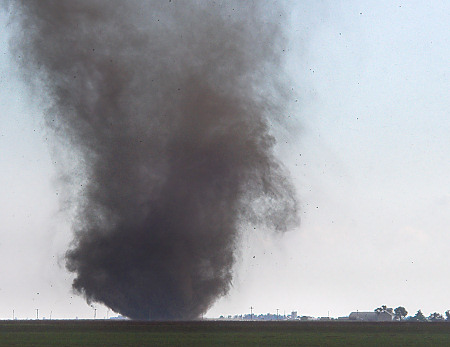
At Burlington, we optioned south just to get into some clear air so we could “breathe” a little easier with respect to staying ahead of all this stuff.  As we went south on US-385 we eventually got far enough south to see some impressive mid level structure with the one cell to our immediate west that had a little meso with it.  This whole area from southeast of Burlington down south to west of Cheyenne Wells, CO was exploding into an impressive HP beast churning up a ton of dust with small scale vortices (gustnadoes) along the gust front.  The gust front wasn’t really surging east that far from the developing updrafts… therefore some of the gustnadoes almost appeared as if they were hybrid front-flank weak tornadoes.

There was really interesting cloud base rotation at various portions along this inflow/outflow interface where the new updrafts were going up vigorously.  At these locally enhanced areas of rotation, the dust would organize in a column and rise up to meet the cloud base rotation.  Really, really interesting!

We actually took a dusty farm road east through all this stuff… north of Hwy 40 between Cheyenne Wells and Arapahoe.  At various points along this adventurous dusty drive, the visibility went to ZERO in dust with northwest winds around 40 to 55 mph or so.  Jon and Mitch were shooting video during all of this and I’m looking forward to seeing how that turned out.

We got back to US-40 and blasted east to Weskan, KS.  Near Weskan, we looked off to the north into the notch of this HP beast.  There was an impressive column of dust that looked better than any other dust column we had seen and it was right where radar was indicating strong shear.  It’s possible we were looking at a weak tornadic circulation back in the notch.  I was able to get a couple photos of this while we were driving east, but it’s fairly inconclusive as to whether this was really a tornado or just a well developed gustnado.  Probably a hybrid?

_DSC3757.jpg

_DSC3758.jpg

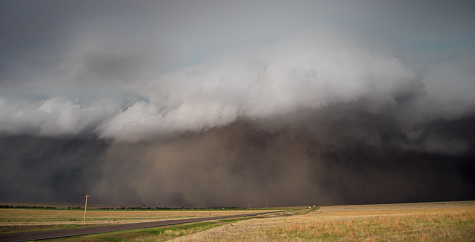
Eventually, this whole thing became one giant dust storm at the leading edge with haboob characteristics at the front edge.  When we got on the east side of Sharon Springs as this monster storm approached Sharon Springs… the structure was magnificent!  It was just a huge wall of updraft right above the dust wall/haboob.  Wow!  I was fortunate enough to capture all of this on the digital SLR.  It was an awesome sight!  We finally aborted the chase northeast of Wallace and backtracked through the storm back to Goodland where we stayed for the night.

_DSC3792.jpg

_DSC3836.jpg

Here’s what my Jeep and Jon’s Cavalier looked like after our zero-visibility dust pursuit… caked with northwest wind-blasted dirt:

_DSC3865.jpg

_DSC3869.jpg

May 31, 2006

Chase Trip 2006: Day 8- Northwestern Panhandles (supercell & other outflow dominant storms)

Filed under: Chase Accounts,Chase Trip 2006,Storm Chasing — Mike U @ 7:56 am

Jay, Rob, Mitch, Jon, and I left Dodge City around 1:30pm and headed west to Lamar, CO. We were undecided as to whether to play the Palmer Divide or the Raton Mesa as both looked pretty good for a supercell thunderstorm. When we approached Lamar, a check of the latest data revealed that the Raton Mesa area to our south had higher CAPE air (more instability). Both areas had about the same shear. At Lamar, we headed south towards Springfield, CO as storms were beginning to form south of Kim, Colorado on the mesas along the NM-CO state line.

We decided to intercept this storm west of Campo. We headed west about 15 miles and approached the updraft of this storm to out west-southwest. There, we met up with Al Pietrycha and Dave Floyd from Goodland. Dave had some bad luck blowing not one, but two tires on this road we were on. After helping Dave out getting back on the road, we backtracked to the east towards Campo. Along the drive back to Campo, our storm was becoming better organized, with a decent wall cloud to our southwest.

_DSC3535.jpg

It didn’t take long for this storm to become outflow dominant. Soon, more storms were forming to our immediate southeast through southwest. With timely radar updates on the road, we decided to core punch this mess to get on the south side. We finally made it to the other side just north of Boise City. (on the radar images, the circled dot indicates our GPS location)
screenshot1a.jpg

Our storms were organizing into a linear system with a well-structured shelf cloud. We found a spot to photograph the shelf cloud about 3 miles south of Keyes at the intersection of Hwy 171 and 64. (radar below at the time of the photograph)
_DSC3572.jpg

screenshot2a.jpg

We then continued south to intercept the tail-end storm of this line which revealed some supercellular characteristics, but the storm fought a losing battle with cool outflow from the storms to the immediate north.

_DSC3611.jpg

We ended the chase near Dalhart and headed to Clayton for the night. All in all, another pretty good storm photography day, so I’m happy.

_DSC3614.jpg

May 30, 2006

Chase Trip 2006: Day 7- Southwest KS (photogenic sunset storms)

Filed under: Chase Accounts,Chase Trip 2006,Storm Chasing — Mike U @ 7:57 am

Jay, Stacie, and I left Lawrence around 1pm and headed for a target area around the Hutchinson-Newton vicinity. We met back up with Rob, Mitch, and Jon in South Hutchinson at a roadside historical marker at the intersection of Hwy 96 and 50… where we awaited convective development in our target area for quite awhile. A large multicell complex of storms had developed well to our south near Alva, OK which was about 80 miles from us. We decided to forego this in hopes of development closer to our west.

After becoming increasingly impatient, we decided to drop south as the towering Cu to our immediate west and northwest just weren’t doing much. We intercepted a small complex of three storms in northeastern Pratt County, two of which were right-left split members that broke off before we got to the area. The left split which was moving just west of due north…was the healthiest of the three. We headed north through Langdon after we drove south about 20 miles…then back west. The storms just weren’t all that photogenic as observed from the east. We decided to get west of the storms and shoot the backside of them as sunset approached.

The left split soon died, but we were rewarded from our decision to move west…as the sky from north through east through south was very photogenic with beautiful mammatus and a golden wheat foreground. This is why I love Kansas! I had a very unique sunlight ray phenomenon (called an anticrepuscular ray) that lit up the eastern horizon in a vertical triangular column. It was extremely impressive and I was fortunate enough to capture this with nice foreground.

_DSC3456.jpg

_DSC3478.jpg

After hanging around here along Hwy 50 in Stafford County, we decided to continue west back to Dodge City. A new storm was developing just west of us which began to take on beautiful colored structure. The colors were just incredible! I couldn’t believe it.

_DSC3506.jpg _DSC3512.jpg

We stopped again to photograph this little storm… then headed west some more before stopping one more time to photograph the Cumulonimbus looking back to the east after sunset as these new storms were becoming better organized.

_DSC3521.jpg

This morning, Day 8, we are in Dodge City. Stacie’s last day was yesterday, so she had to begin here drive back to Fort Worth this morning. Jon, Rob, and Mitch are at the Super 8 here in Dodge and Jay’s here at my place… It’s been storming here in Dodge since about 5 am. A lot of rain and thunderstorms in western Kansas this morning.

It’s still unclear where we’ll be heading today. I’m liking Southeast Colorado upslope by early this evening. This is subject to change, however.

« Newer PostsOlder Posts »

Powered by WordPress