High Plains Drifter


disclaimer:  "The meteorological views/forecast thinking expressed are those solely of the author of this blog
and do not necessarily represent those of official National Weather Service forecast products,
therefore read and enjoy at your own risk and edification!"

May 29, 2006

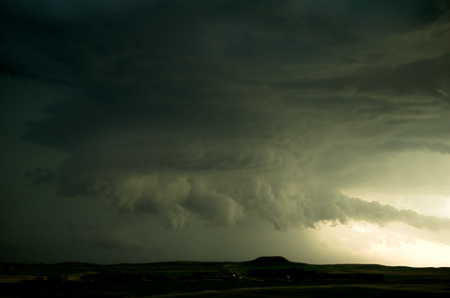
Chase Trip 2006: Day 6- Far northeastern ND (marginal LP supercell)

Filed under: Chase Accounts,Chase Trip 2006,Storm Chasing — Mike U @ 1:21 am

Jay, Stacie, and I are currently on I-29 heading south between Fargo and Aberdeen at this time. Jon, Rob, and Mitch are behind us about 10-15 miles. Day 6… what a day of decisions. We left Bismarck with a target of south-central SD in mind. We drove about 30-40 miles and Jon Finch called asking if we were chasing the Devils Lake, ND area today. I told him no, because we needed to get south for logistical reasons. After Jon called, we actually started interrogating this area for a kicks and giggles. It looked really, really good to us. We were trying to figure out why we would want to blow off a very convergent low center area with upper 60s dewpoints and nice southeast to east southeast winds…along with an outflow boundary. After talking this possibility over with Rob, Mitch, and Jon, all 6 of us decided that we couldn’t resist this area. It was actually the closest target to our location at that time.

We turned around before we got to SD back north on US83 — target of Devils Lake. The ob was persistently very good at Devils lake in the mid 80s with upper 60s dewpoints and a southeast to east southeast wind. The only thing that had us worried… and was quite risky…was the lack of upper level flow and the proximity to the Canada border. Storms would be moving with a pretty decent northerly component.

After a lunch in Devils Lake, we hung around at the shore of Devils Lake awaiting initiation of storms. A small storm did eventually develop… leading to a fairly picturesque LP supercell near Cando. As this storm developed, however, the old outflow boundary was pushing back to the south into our area with northeast winds and stable air. This killed any possibility of tornadoes. The base on our storm was high to begin with. This storm eventually suffered a quick death given its small overall size. Other similar storms tried to go up southeast of this original storm, but failed. The outflow boundary was just too much for this area. It didn’t simmer enough north of the boundary, and this was a significant failure component.

So, we ran into Tim Samaras, Joe Golden, Carl Young, and company before we got to I-29 about 17 miles south of the international border; sharing the laments of the pitiful 2006 chase season up to this point. It’s always fun to run in to other chaser friends at various points during the trip.

[~2.5 hrs later...]

I-29 now exit 114 South Dakota. It was 83 degrees a few minutes ago and quite windy at that last pit stop… we may have had a bit of a heat burst from some dying storms, I guess. We noticed lightning to the southwest about an hour earlier which had diminished. Listening to Art Bell right now; it’s helping keep Jay going :)

Here’s a photo of the LP marginal supercell from yesterday’s chase near Cando:

_DSC3442.jpg

Now here’s an interesting photograph. Jon’s car is an essential feeding frenzy for a large conglomeration of flies, bees, and other small flying critters. A gourmet of an assortment of splattered dead bugs attracted all these flies and bees… yeah, rather unpleasant, but had to document this feeding frenzy:

_DSC3424.jpg

For Day 7 (Monday 5/29) we are targetting the tail-end of the front where a pseudo-triple point of sorts may set up in south-central KS. This target will be on the edge of moderate 500-250mb flow, but CAPE should be high and convergence appears to be strong enough according to the NAM model to get a storm to go up… although it may be late. If not, then we just drive back to Dodge for the night, so Stacie can begin her trek back to Fort Worth. Dodge City appears to be a good location to setup for Tuesday’s chase from western OK to northeastern NM. More later from this kamikaze drive, perhaps!

May 28, 2006

Chase Trip 2006: Day 5- Central ND (supercells)

Filed under: Chase Accounts,Chase Trip 2006,Storm Chasing — Mike U @ 6:50 am

A much better chase day on May 27th in North Dakota!  We intercepted storms northeast of Bismarck, one of which becoming a meaty supercell between Wing and Regan.  The structure on this supercell was quite nice.  We followed this north until it weakened, and as it shriveled up, there was visible rotation at cloud base…with even a nascent funnel it appeared looking WSW towards the shrinking updraft area near the Florence Lake NWR.  At Denhoff we travelled west to catch the backside of these storms.  We almost drove into a 72 VIL core (golfball hail or larger), but thanks to a timely radar update, we obviously reconsidered going south on Hwy 41 at Mercer… and optioned farther west dropping south on 200 Alternate to Washburn.  The backside of the supercells were very photogenic with just incredible deep saturated colors of pink, violet, blue, orage… you name it.  It was stunning color contrast right at sunset.  We ran into very brief quarter size hail just northwest of Wilton then decided to stop off at the intersection of Hwy 83 and Hwy 36 to photograph lightning from the southern most supercell that was over Mandan-Bismarck.

We are in Bismarck this morning and plan to leave here probably around 10am for a target near the SD-NE line west or northwest of Valentine, NE?

_DSC3299.jpg

_DSC3307.jpg

_DSC3362.jpg

_DSC3404.jpg

_DSC3410.jpg

May 27, 2006

Chase Trip 2006: Day 4- Northwestern SD (non-severe storms)

Filed under: Chase Accounts,Chase Trip 2006,Storm Chasing — Mike U @ 8:38 am

I’ll try and make this brief, since I need to do a forecast for today’s chase. We are in Dickinson, ND this Saturday morning. We left Gillette, WY yesterday afternoon and followed high based, non-severe storms from the Belle Fourche area north to near the North Dakota state border south of Dickinson. There just wasn’t enough moisture to sustain good, organized severe storms/supercells. It was pretty much a bust, for I thought we’d at least see a picturesque supercell. Oh well. My website is currently having some issues, and I’m lucky to get this blog update out, if I can. I’ll try and post pictures soon if the site can come back alive.

Today (Day 5), we are targetting an area between here and Bismarck it appears. The RUC breaks out storms in this area along a stationary front extending southwest to northeast across ND… from a deep surface low over Wyoming. Unclear what kind of storms we’ll be dealing with, but there’ll be higher CAPE today.

Here are some photos from yesterday’s chase:

_DSC3168.jpg

_DSC3217.jpg

_DSC3204.jpg

May 24, 2006

Chase Trip 2006: Day 1- South Central NE (marginal supercell)

Filed under: Chase Accounts,Chase Trip 2006,Storm Chasing — Mike U @ 6:55 am

Jay, Stacie, and I targetted the area around Phillipsburg by mid-late afternoon where surface convergence appeared to be maximized. We tried to stay as far south as we could as it appeared most of Nebraska would erupt in too many storms. It turns out that indeed happened. The problem was, storms in our target area were developing out ahead of the boundary layer convergence or the remnant Pacific cold front itself. We monitored trends in radar and the sky, and it just wasn’t clear which storm was the best to intercept. Finally, around the town of Guide Rock, we stopped to let the atmosphere hopefully straighten itself out in hopes that a coherent severe storm could evolve.

We watched a small storm approach us from the southwest near Guide Rock both visually and on radar, which had up to 65 VIL at times. As the storm got closer, we could hear a faint hail roar. We continued east about 5 to 7 more miles to stay ahead of this marginally severe storm. We stopped a couple times east of Guide Rock to photograph the structure of the updraft of this storm, which was somewhat respectable. It appeared marginally supercellular-ish when it was between Guide Rock and Nelson…to the southeast of the main developing SVR line forming on the cold front. We went north on Hwy 14 and our storm became worse looking visually. We met up with Matt Crowther and Jim Leonard north of Nelson and continued east on Hwy 4.

The rest of the chase just sucked.. at least for me. Storms on the cold front began to get much better organized to our west-northwest. We decided to hang out for awhile at this location on Hwy 4 somewhere not too far west of Davenport. The light was getting low, so I decided to set the tripod up for photography. Inflow winds were gusting to about 30-40mph from the southeast… which was promising! I left my tripiod un-attended for about 20 to 30 seconds or so out of reach. You can guess what happened next. I don’t have my heavy duty Manfrotto tripod with me, but more of a lighter-weight landscape photographer’s tripod legs. Anyway, the tripod fell forward, lens-first onto the gravel road. I completely busted my 18-70mm lens. The body is okay, though thankfully. So that was about a $300 lapse in judgement not paying attention with very strong winds. It’s a good thing we are in a fairly decent sized city (and I have some supplemental cash) so I can replace this lens right away. I missed out on some decent low light structure shots as we were driving north on Hwy 81 in Southern Fillmore County…. oh well. It’s only Day 1….

_DSC3032.jpg

Today: We had talked about chasing southeast KS last night… or at least considered the option… it’s not even 8am yet as of this time. We may blow off today, like we had originally thought and head west (after I buy my new lens) towards western Nebraska. The NAM and GFS are now throwing a bit of a curve ball at us with regards to Friday and Saturday… it’s showing more of a "dirty ridge" scenario now across the central High Plains… where enough flow could cut underneath into western KS to make things just interesting enough. Both the NAM and GFS develop storms just north of the thermal low somewhere in Northern KS on Friday. I think by heading into western Nebraska… like Scottsbluff or something… we can keep this option open… because it still isn’t exactly clear.

May 14, 2006

Chase Acct: May 9 (TX Panhandle)

Filed under: Chase Accounts,Storm Chasing — Mike U @ 1:38 am

I left Dodge around 11:30 am and set off to Boise City, OK. High based storms formed over the Raton Mesa early in the afternoon and rolled east to the TX-OK-NM tri-border northeast of Clayton. I actually intercepted this stuff before the outflow did it’s number to this whole area given dewpoints in the upper 30s or so. It was at that point that I had to seriously re-consider the rest of this chase as far as logistics were concerned. It was about 4:30pm and hires sat suggested turkey towers way down south near Plainview. Other towering Cu were going up north of this area on the retreating warm front that extended northwest to southeast across the southern TX Panhandle. The best convergence…albeit weak…was setting up just southwest of Amarillo (AMA). Theta-E nose was point right up towards Palo Duro S.P. just southeast of AMA. Knowing that the upper jet was digging southeast into this area… this was now my target… about 150 mile drive from where I was watching those garbage storms east of Clayton. Calculating my route, I could get down there by 6:30 or so. Thank god I had cell internet access to keep a close eye on the TX Panhandle obs and 1km vis, otherwise, I would have likely been completely lost with so much Cu development.

I got to AMA with convective initiation occurring to my south-southwest as well as just northeast of the AMA metro, refueled in Claude, and plotted a track to the southern-most storm of this AMA-area stuff. I dropped south from Claude through the Palo Duro Canyon…watching a nice looking left-split approach me just south of Claude. I continued south towards the right-split near Wayside. Storms were also continuing to organize back to the north near where I originally was on the northeast side of Amarillo. NWS AMA dis-continued the warning for awhile with the Wayside storm, as it did in fact look a little less interesting on radar… but the supercell was just in a re-organizing stage as it turned out. Driving through the canyon, I encountered nickel size hail about 7 NE Wayside. I finally got south of the forward flank precip core in the southern portion of the canyon with a spectaular view to the immediate northeast overlooking the incredible canyon terrain — there was a marked distinction between the precip core and the updraft of the storm.

This storm was moving due east initially but began to right turn once it got into far southeast Armstrong Co. There are zero road options east unless you go south to Silverton. Since the storm was now right moving with a slight south component to it… this wasn’t that big of a deal. I was rewarded with spectacular Cb structure (1 2) looking 10-15 miles northeast. At the same time, there were two more supercells off to my distant southeast… a left and right split it appeared. I stopped on Hwy 207 at Tule Creek northwest of Silverton to get some more Cb structure shots with some of the beautiful terrain in this canyon area around the Mackenzie Reservoir. Jim Leonard and company (1 2) passed me at this point… he thought I was photographing some deer Wink They would be the only other chasers I would encounter on this chase.

I continued east on Hwy 256 with just enough of a cell signal to download a radar image about every 10 or 15 minutes. A meso was being indicated just southwest of Brice which was about 12 miles to my northeast. My road was now going northeast, but the storm was now moving more southeast… so I had to jump on Hwy 70 and head to Turkey to stay removed enough from this beastie and not get munched by this now full-fledged mature supercell. I stopped periodically along Hwy 70 to shoot Cb supercell structure to my northeast. The most dangerous portion of this storm was now in central Hall County approaching Parnell. The sun was now setting — providing some brilliant orange and pink hues. I photographed from a stopping point just on the northwest side of Turkey just after sunset to get these colors. I was now amidst the photographer’s “magic hour” and the supercell to my northeast was now just a monster! A cumuliform backsheared anvil was just one of the amazing characteristics of this storm that revealed its furocity — spawning numerous reports of baseball hail apparently in the Parnell to Estelline areas.

I hopped on Ranch 656 in order to remain in an optimal viewing position to the supercell updraft’s southwest. I stopped about 3 miles outside of Turkey around 8:45 and setup the tripod. Intra-cloud and cloud-to-cloud lightning was constant. The sight was just amazing; a convective cathedral with just incredible visibility. It made photography very easy, to say the least. I remained at this location for a good 20 minutes (1 2 3)… then continued east-southeast on 656 for another 15 minutes before stopping again to photograph long exposure structure with the in-cloud/cloud to cloud lightning. A near full moon provided just enough ambient light that leaving the shutter open for a good half a minute allowed the resultant image appear as if it was still early twilight. I sat at this location for probably a half hour, just soaking it all in. It was during this time that Childress got hit… so I was now some 30 miles west-southwest of the storm as it continued to move east.

Shortly after 9:30 I continued east to Northfield and through Tell…eventually taking me into Childress so I could get back on a major highway. I rolled into Childress to find the power out… some sign damage at the intersection, a leaned over power pole… and a tree across the south-bound lane of Hwy 83.

After this encounter, I began my trek home… along the way stopping a couple times for more long exposure photo opportunities taking advantage of the full moon. What luck to get a full moon to provide some light on the clouds! Did some artistic convective cloud motion blur stuff with 30-60 second time exposures… which turned out fairly well (1 2).

I drove back to Dodge in a chilly stratiform rain getting back home around 4 am — an extremely rewarding chase with exactly the outcome I was hoping for!!

Photo Gallery >>

http://www.underthemeso.com/gallery2/stormchase/chase06/2006may09/

Mike Umscheid

May 7, 2006

Chase Acct: April 22 (West TX/NM Border)

Filed under: Chase Accounts,Storm Chasing — Mike U @ 10:24 am

April 22nd wasn’t exactly the most exciting chase of my life, but I didn’t expect to see truly spectacular storms either. I decided to chase because it was during my 3-day weekend, and the setup appeared marginally favorable for sustained supercell thunderstorms rolling off the high terrain of eastern New Mexico into moist, unstable air in West Texas. I departed Dodge City around 8:30am or so for a target around Clovis. I was banking on initiation of storms near the Tucumcari-Clovis areas or the far southwestern Texas Panhandle by late afternoon. I arrived in Clovis around mid-afternoon only to find south-southwesterly winds at the surface and dewpoints in the 30s. Convergence was weak at best in this area and the flow certainly wasn’t of upslope component — which was rather frustrating. I had to make a decision at this point whether to completely call this chase a bust and head back home empty-handed… or continue on to the south where there was much better low level forcing in southeastern New Mexico to the northeast of Roswell.

In Portales, a quick check of the radar and satellite clued me into convective development initiating off the Sacramento Mts west of Roswell-Artesia. As the storms developed eastward towards a Hobbs-Tatum line, I vectored myself towards the Tatum area where the closest, strongest cell on radar was of easiest intercept.

At Tatum, I re-fueled and checked radar, noticing the best storm on radar was now about 30 miles or so to my west-southwest. I drove west on some ranch roads to a stopping location about 20 miles west-southwest of Tatum. I sat at this location watching this weak storm slowly drift east towards me. The storm remained below severe levels and the structure was not exactly that picturesque. The high-based storm did offer an opportunity to photograph some cloud-to-ground lightning. This was my first crack at daytime lightning with my Nikon D70 DSLR using a 3-stop ND filter and a circular polarizer to block a total of about 4-stops of light allowing me to leave the shutter open as long as 1 or 2 seconds. I managed to capture these two (1 2) shots with a windmill in the shot. After about 20 minutes or so, high level mammatus-type cloud structure was streaming over my location beneath the anvil canopy.

I continued north to Hwy 380 as a new small storm was developing to my west. When I got to 380, I stopped for about 5-7 minutes to try and photograph more CGs to the immediate west. I did manage to get this one captured in this 5-7 minute window before the rain started and the storm got too close. I reached Tatum again and headed north from there on Hwy 206 to Crossroads. The storms developed and weakened in a pulse-like fashion in this area, but as each new storm went up, it appeared to be a little more organized than the preceding one. I followed state Hwy 506 to the TX state line, stopping every few miles along the way to photograph lightning from inside the car using my suction cup mount. I did get out for a brief moment to get a few structure shots looking west and northwest. At sunset, the sky became increasingly orange and violet in hue towards the horizon, which was rather photogenic.

Here are a few of the CG shots I managed to get looking north to northeast from near the TX-NM state line southwest of Bledsoe: 1 | 2 | 3 | 4. Of course, it was darker by this time, so it was easier to capture CGs with longer shutter speeds of around 8s each or so. This particular storm producing the CGs near Bledsoe was moving off to the northeast away from me, and with nothing much else near-by, I decided to begin my ~6hr trek towards home. I took state Hwy 214 north from Morton to Needmore where I had to follow a detour west a few miles. It was after 10pm at this point, and I noticed a couple new storms going up to my west as evident by increased lightning activity. Heading west on this detour route west of Needmore, some of the lightning was of the “staccato” CG type…with strikes about one per minute or so. I finally hit the north-leg of this detour a few miles ahead and pulled off to setup the tripod. There was essentally no ambient light from city lights or anything, so I could keep the shutter open as long as I wanted to on “bulb” setting to see if I could get anything. After about 10 minutes of sitting there, and missing a number of the stacatto bolts, I finally got one on the left side of my frame. I knew I had a couple of trees in the foreground of this shot that I had as landmarks for my composition, but it wasn’t until I got home from my chase in the morning when I realized I happened to get this particular lightning strike dead-center immediately behind one of the trees. The storm moved slowly east just north of me and I got one more decent lightning photograph before I left. The staccato lightning shot was the one shot that made the 800-mile round trip worth it!

I didn’t get home until shortly after 7am, having to stop every couple hours or so for catnaps, since I was chasing solo. It was a fun chase, and good to get out of town for a day, despite not seeing a supercell storm.

Photo Gallery >>

http://www.underthemeso.com/gallery2/stormchase/chase06/2006apr22/

Mike Umscheid

April 27, 2006

Chase Acct: April 23 (Southwest KS)

Filed under: Chase Accounts,Storm Chasing — Mike U @ 11:16 pm

I intercepted two gorgeous high-based severe storms on Sunday 4/23 not too far from home, for a welcome change! Sunday actually began with me arriving home from a long chase in West Texas on Saturday 4/22 (chase account forthcoming soon) where I intercepted some marginal high based storms and photogenic lightning southwest of Lubbock. I arrived home from that chase just after sunrise around 7:15am. I slept from the time I got home until about 12:30pm or so, given the fact I knew that Sunday’s chase would be close to Dodge City.

Since the tornado threat Sunday did not look all that spectacular, I wanted to target where the best opportunity for photogenic high-based storms would be. By early afternoon, some high based showers developed in 20s dewpoint air over far southeast Colorado which were moving east into Southwest KS. Around 3pm or so, towering Cu were developing on the dryline finally in the far eastern Oklahoma Panhandle. I decided to target this area, about an hour’s drive away.

I left Dodge around 4pm or so heading south on Hwy 283. At Minneola, I fueled up and noticed the darkening skies to my immediate southwest where those high based showers were coming from (that had originated from Southeast Colorado). One of these showers was holding together pretty nicely with a small, dark base noticeable. As I was driving south, this shower (now thunderstorm) was perking my interest more and more. I decided to pull off and just watch this for a little bit instead of just blasting south to the OK border. When I got out of the car, the first thing I noticed was a strong southeast wind. Lower to mid 50s dewpoints were lingering just into northwest Oklahoma, so this little sucker that had survived through most of Southwest KS was about to move into much better Theta-E air (instability). About the point that I first stopped, I noticed a somewhat impressive dust foot to the north of a weak rain shaft. Since this storm was still in low dewpoints, the relative humidity was quite low, so dry microbursts were fairly common. More and more, the high base on this storm was becoming better organized, and it didn’t take too long for me to decide that I was staying on this newly developing storm just south of Minneola.

For the next 20 to 30 minutes, I watched the updraft base of this storm become darker and darker looking with cloud-to-ground (CG) lightning becoming much more prevalant and dangerous. The base had that finely-textured scalloping look to it that is a common characteristic of a high-based severe storm on the High Plains. I continued east on a farm road about 6 miles west of Clark State Lake (~9 SE Minneola), as the storm was rapidly developing into a severe storm with dangerous CGs. The CGs were so bright and vivid, I had to try and capture one with my camera. I stacked a 3-stop neutral density filter with my circular polarizer filter to try and increase shutter speed to a couple of seconds at f/8. The lightning was frequent enough that I did capture at least one decent CG to the north. The CGs were so dangerous and close that I couldn’t get out of the car. In fact, one CG started a pretty significant grass fire to the west of my location. The farm road I was on was taking me to the south and east through some pretty neat terrain in Clark Co. south of the lake. Here is a shot looking west at the updraft base of the storm as I was driving south towards Ashland. I passed at least 4 fire trucks on this lonely road as they were responding to that lightning-sparked grass fire.

I found a decent stopping point a few miles north of Hwy 160 northwest of Ashland to photograph the storm for about 20 minutes or so. (1 2 3). With the main updraft portion of the storm moving east, I had to continue east on Hwy 160. I stopped at the intersection of Hwy 34 with this view to the north-northeast. The storm was still holding its own, but it wasn’t necessarily getting better looking as it was moving off to the east-northeast. With this in mind, I was keeping a keen look-out for anything new developing farther to the southwest.

A few miles east of Protection on Hwy 160, I stopped to re-evaluate things. My original storm was looking far less photogenic to the north-northeast. I noticed a healthy looking storm on radar in far northwest Oklahoma that I was now wanting to set my eyes on. I turned around and drove back west on Hwy 160. To my immediate southwest was a growing elongated dark base. A new strong updraft was going up just to my southwest in the Sitka area. I opted to head south at Sitka on Hwy 183. This elongated base extended east to west just north of the Cimarron River where road options are few and far between in southeastern Clark and southwestern Comanche Co. My first plan was to drop south all the way to Hwy 64 near Buffalo, which would be a long route away from the updraft. I got as far south as about 6 S Sitka, with this view to the northeast, before I changed my mind and headed back north and try a different route — a route through the core of the storm. My reasoning for this was because this would be a far shorter drive to get into position on the southern portion of the storm as it moved into southern Comanche Co., and I figured this storm wouldn’t produce anything larger than isolated golfball size hail. Planning ahead, I figured I could get a good view of the storm along Hwy 1 near Buttermilk if I drove back east again on Hwy 160 to 4 S Coldwater.

So east I went through the core with sporadic bouts of nickel to quarter size hail between Sitka and 4 S Coldwater on Hwy 160. I dropped south on Hwy 1 and escaped the core on the south edge of the storm after about 4 or 5 miles drive. I was rewarded with a wonderful view of the storm to the north from near Buttermilk on Hwy 1. Looking at the map and knowing the storm motion being almost due east… I noticed a road on Delorme going due east through far southeastern Comanche Co. that headed towards Aetna in southwestern Barber Co. I figured this road would be just about perfect distance to get good structure shots as the sun was getting low on the horizon. Sometimes the logistics just work in your favor, and from this point forward until just after sunset, I managed to get some beautiful storm photography all along this road from Hwy 1 east to the Okla. state line intersecting the Barber Co., KS line about 4 SSW Aetna. Here is a series of photographs from along the Aetna road in far southeastern Comanche Co:

1 | 2 | 3 | 4 | 5

Right around sunset, the road was taking me southeast towards the Oklahoma border where the Gypsum Hills offered a wonderful stormscape scene. The colors in this perfect soft-light were incredible: 1 | 2 | 3 | 4

The storm was continuing east and the best structure was beginning to fade away along with the good light, so I turned around and began my trek back towards Dodge City. What another awesome high-based storm structure shoot!

Photo Gallery >>

http://www.underthemeso.com/gallery2/stormchase/chase06/2006apr23/

Mike Umscheid

April 21, 2006

Chase Acct: April 14 (Northwest OK)

Filed under: Chase Accounts,Storm Chasing — Mike U @ 11:01 am

Last week (Friday 4/14) I chased an impressive high-based supercell thunderstorm in Northwest Oklahoma. This chase was one of those “high-risk, high-reward” type of chases in that it appeared to be a very marginal setup for supercells, and especially tornadoes. I was off work last Thursday and Friday and was watching the Friday setup with some interest along the dryline. What perked my interest in the setup for Friday was 1) a subtle triple point convergence of the dryline and a washed-out, weak front that had slowly pushed into far northwest OK… 2) long hodographs with 50-70kts of upper level winds… 3) intense afternoon heating into the lower-mid 90s to allow the cap to break. The NAM model was also showing a very small area of convective precip in about 3 or 4 consecutive runs, which was a pretty strong signal that initation may occur in far western/northwestern OK. I figured if initiation would indeed occur, it may just be one or two storms given the lack of an upper level system to enhance deep tropospheric lift. It would just be mainly boundary layer forcing. I also figured, from a photographic standpoint, that a supercell in this environment would be very photogenic. This was the forecast I posted in a storm chase discussion group the day before (Thursday 13th):

“There may be an opportunity for a picturesque storm in far northwest OK late tomorrow aftn/into the evening. It appears there will be weak to modest sfc convergence as this weak front/wind shift stalls out creating somewhat of a triple point with the downslope plume extending northeast from eastern New Mexico. The thermal nose of the NM downslope plume should be over the far northeastern TX Panhandle/far NW OK where highs should soar into the mid 90s once again. Model Tc of ~36C in this area so add in a little convergence to get things going, and there could be a storm. Deep layer shear looks pretty good with 270° flags down to about 8km AGL. If there is enough convergence to get a good mass of DMC going, there just might be a little high based low end supercell surprise. From a photography standpoint, I like these subtle looking possibilities… I’ll keep an eye out” -Mike U

On Friday, after I came home from running some errands around town, I pulled up a visible satellite image and radar and noticed storms already developing along the TX-OK border near the Canadian River…this was around 3pm. I was pretty much set to go, so after I saw this, I blasted south out of town. It’s about a 2-hr drive straight south to that area from Dodge City. I reached Laverne where I fueled up. In Laverne, there were two areas of towers going up…one to my immediate southeast and another area of more intense development of towers/weak storms to my distant south… probably near the Canadian River. I did not have radar data because Northwest OK is pretty much void of service for my Alltel aircard. This was not a problem, though, because my eyes are far better tools for me than radar. I continued south to the town of Arnett with this view to the southeast at pretty hard looking high-based towers and a weak storm underway. This whole area to my south and southeast now was becoming quite convective looking. It has been my experience that if there is a “towering Cu hot-spot” where towers would go up, anvil out and die… which repeats for 2 to 4 iterations in the same location…. that this indicates a very susceptible area for vigorous convective initiation in the not-too-distant future. This was occuring very near the Canadian River north of Roll, OK. I drove south to the Canadian River on Hwy 283 with this view looking east as I crossed the river. A mature updraft base was now underway and it appeared as if I was in pretty good shape for a nice storm.

I got south of this area when I reached Roll, which is where I continued east on Hwy 47 just south of the river. These photos (1 2) were looking northeast at the maturing updraft. I found a high spot overlooking the open prairie to the northeast with a dark updraft base just off to my northeast now. The storm was rapidly getting much better organized. With high temperature-dewpoint spreads (lower-mid 90s over mid 50s dewpoints)…downbursts would probably occur in the forward flank region of the storm. I continued driving east with the storm updraft becoming very well organized now (1 2 3). Continuing east, I was finally getting east of the updraft as I approached the town of Leedey. My first stopping point just east of Leedey offered this view to the northwest at a well-sculpted supercell updraft base! The precipitation core immediately downwind of the updraft base was becoming very intense. The beginnings of an impressive rain-foot, which denotes very strong surface winds from a downburst, were becoming apparent.

The visibility was just absolutely superb and there were no other storm chasers around. Not one — which is an incredible feat for being on a supercell thunderstorm in Oklahoma in April in this current era of storm chasing. Given the fact that tornadoes were NOT what I was after this day, I gave this one a more serious meteorological consideration than a majority of other storm chasers would. Watching this high-based storm with no other chasers around reminded me very much of my May 4, 2002 intercept of a gorgeous high-based supercell near Medicine Lodge, KS — another similar kind of setup with very subtle thermodynamics and kinematics, but enough to get one beautiful storm.

Back to the chase account… this storm offered some of my best rain foot photographs to date. When you drop a ton of water into a near-surface atmosphere with fairly low relative humidity, interesting things can happen. This is about as good as it gets for a supercell structure photographer! This was exceeding my expectations for the day for sure. Here’s a vertical compositon. Another wide angle shot of the supercell updraft, the forward flank precip core, and one of the most impressive rain-foots I have ever seen.

With the storm moving due east around 25 mph, I had to keep driving east to stay ahead. My next stopping point would be somewhere between Rhea and Burmah in southwestern Dewey County. This was the structure of the supercell from this location looking west-northwest. About 15 minutes later and about 7 miles farther east, I had this view (1 2). As I approached Hwy 183 near Putnam, the storm was beginning to shrivel up a little bit. This shot was looking west down Hwy 47. I expected this storm to diminish given the environment not supporting long-lived storms, although I didn’t expect it to meet its demise this soon. I continued east of the intersection of Hwy 183 about 4 miles and then optioned south to try and get better lighting looking more north at the storm instead of west-northwest into the sun (harsh contrast). Here’s one last vertical shot looking northwest in fairly harsh light with a young wheat field in the foreground.

I back-tracked west a bit on Hwy 47 to get a better lighting angle on the storm looking north. I wasn’t dissapointed… I had some great views of the waning storm with an impressive hail shaft overlooking green fields. More photographs from this same location: (1 2). I reached Hwy 283 again and tracked back north towards home. A rainbow offered a wonderful landscape photo opportunity. This is what was left of the storm looking off to the east from just south of Putnam. Here are a couple of shots with my 80-400mm zoom lens (@400mm) at the convection in the updraft (1 2).

I got back home in Dodge City around 11:30pm. This was one of the most satisfying solo chases in quite some time… in all facets from the forecast to the logistics of the chase, the location and beautiful scenery along the Canadian River valley to the incredibly photogenic storm structure itself. Chase days like these are hard to top. Onward!

Photo Gallery >>

http://www.underthemeso.com/gallery2/stormchase/chase06/2006apr14/

Mike Umscheid

April 11, 2006

Chase Acct: April 6 (Central KS)

Filed under: Chase Accounts,Storm Chasing — Mike U @ 3:43 pm

I targetted the area from Salina to Concordia, KS for the development of supercell thunderstorms by early afternoon April 6th. I left Dodge City around 10:30am and set out for the Ellsworth, KS area. When I approached Kinsley, however, I decided to continue heading due east towards Stafford instead of northeast towards Great Bend. The short-fuse composite was suggesting first initiation would occur just a bit farther south than I had thought. I loafed around Quivira NWR for a little while when towering Cu were developing to my south around noon. I then decided to go to Lyons to top off the tank and await development. Well, things were happening fairly fast, and I never did make it to Lyons. I filled up in Nickerson and at this time a fresh storm was already underway southwest of Hutchinson. This was my target storm.

I headed south to South Central Reno County with this view looking south. The anvil edge was crisp and I thought I was in business. Storm motion was northeast at around 45 mph and I was driving south around 65 mph so I was vectoring in at a solid 110mph! This is a problem though. It is very tricky with such fast storm motion because you can easily overshoot your storm, believe it or not, especially when it’s in the organization stages like this storm was. I reached the updraft portion of the storm in no time, somewhere southeast of Arlington. The updraft base was rather pathetic looking with little organization. I think this initial updraft croaked and the storm was reorganizing when I finally got down there. After farting around with some technical difficulties with power to my laptop, I was rapidly falling behind. I had to get back north in a hurry. I did recover… but a new well-developed Cumulonimbus (Cb) was visible to my north-northwest about 25 miles away. Not that far away, but even at this distance, it would be nearly impossible to intercept. Never fear though, new hard towers were developing to my immediate west. I followed these towers north to ~7 W McPherson.

This elongated area of towers eventually evolved into a storm just west of McPherson, but it took awhile for this area to congeal into one big storm. I reached I-135 at McPherson and continued to follow this storm north. The storm was now beginning to look a bit better with a rain-free base area with a hint of a lowering to my west. At Exit #78 I got off the interstate (Hwy 104) with this view shortly after getting off the interstate looking west-northwest from a location about 2 miles north of Assaria (~7 S Salina). The updraft area of the storm was taking on a much better organized structure and I figured I was in business. Problem: a fairly large city to deal with in Salina. I was off the interstate by this point and I was banking on enough of an eastward component in the storm motion to warrant being a bit farther east. Another view looking west from just south of Salina.

The storm was rapidly evolving into what was looking like a high-precip supercell (view looking southwest). Looking west towards Salina. I navigated through Salina on the far southeast part of town so as to limit stop & go as much as possible. I went east on Magnolia road to finally get far enough ahead of the storm to get some better structure. A critical decision making point was coming up: do I stick with this storm and blast north or do I try and catch the next storm developing to my south. I was not liking the “wet” look to the Salina storm. At the same time, though, the best observable updraft structure was rapidly departing my view and it was more difficult for me to interpret what was really going on with the Salina storm. The best views were to the northeast of the storm. I was now rapidly becoming southeast of the storm. More shots of the structure looking northeast (1, 2, 3) from ~6 E Salina. Here’s a look to the northeast… my last look at the storm now rapidly moving away from me. This is the last good look I had at this storm as it was now approaching Manchester. When I took this photo, I realized I was probably making a mistake letting this storm go. This little bit of hesitation is extremely costly on fast-moving days. The storm produced its first tornado not too long after this shot apparently… and went on to produce tornadoes for the next couple hours near Clay Center to near the Nebraska state line around Hanover.

My focus was now on new development upstream. A formidable looking storm with a beautiful anvil was off to my southwest rapidly approaching. I sat at a location ~5 S Solomon watching this for about 15 to 20 minutes. Meanwhile, another more significant storm was taking shape to my southeast moving up in my general direction to the east. I drove to Abilene where I topped off the tank and continued got on I-70 where I blasted east to Junction City where radar indicated the storm would cross the intestate. On the east side of Junction City, I got off I-70 at exit #298 with the storm to my immediate SSW. It was another wet looking storm with a quiescent looking wall cloud on the northeast side heading for me fast. This would be the last time I would be ahead of this storm. I decided I wanted to get some “backside structure” so I went back into town in Junction City. Got off on exit #296 in town with this view just a few short moments later. This portion of the storm had a decent amount of low level circulation as noted by the edge of the rain curtains rotating around in a cyclonically fashion. This circulation crossed I-70 just a couple miles to the east… right where I was previously located. Good thing I left! I snuck up on this area of the storm by following it on I-70 back east again. It looked insanely dark just up the road and I was getting some quarter to almost golfball size hail on the interstate as I approached Fort Riley.

At the Fort Riley exit #301, I pulled off and watched the backside of the storm. Sometimes the backside of these storms are more picturesque than the front! I photographed the back of this storm for about 20 minutes or so, including some of the hail that remained on the ground at the Fort Riley base. Backside of the storm looking east-northeast from Fort Riley: 1 | 2 | 3

It was around 5:30 or 5:45 by this time and I had to head back home, as I was due in to work at 11pm for my next shift. On my way home, I photographed a few picturesque virga showers around the Great Bend area: 1 | 2 | 3

All in all, it was a fun chase, my first supercells of 2006. I’m a little bummed I missed out on the Clay Center to Hanover tornadoes with the storm I was initially on, but that’s the way it goes with storm chasing sometimes. Another setup very similar to this one, with maybe one or two other subtle things different in the atmosphere, and the storm could have produced tornadoes from McPherson to Salina and I would have been there to document them. Onward.

Photo Gallery >>
http://www.underthemeso.com/gallery2/stormchase/chase06/2006apr06/

March 9, 2006

Chase Acct: March 8 (Srn OK Bust!)

Filed under: Chase Accounts,Storm Chasing — Mike U @ 4:28 pm

Well, I’m not going to elaborate too long on this, but I went on my first long chase of the 2006 season on Wednesday the 8th. Long story short… 6 hour drive to near the Red River in southern Oklahoma to see a *&$!@-load of cirrus clouds. It appeared for all the world that things would erupt nicely after 4pm or so in the target area, and I KNEW ahead of time that there would probably be a significant problem with high cirrus clouds… but I went anyway. Storms did actually develop a bit farther south of my target in the Throckmorton to Decatur, TX areas just around sunset, but it was at least an hour before that when I threw in the towel and headed back to Dodge.

Now that I have another passionate hobby…photographing wildlife (mainly birds) at Quivira NWR… it’s going to take more to get me out the door for these early season marginal events. Especially with the way gas prices are.

A little about my Kyocera/Alltel setup. In looking at the coverage map on the Alltel site, I knew I would be in a world of hurt for data on the road. There is ZERO coverage in northwest Oklahoma north of I-40 and west of I-35. The route to my target area was through this area, and I can verify I could not connect…even though the Alltel software was seeing a signal, I would get a “could not connect to remote computer” errors….all the way from when I entered Oklahoma north of Laverne until I approached El Reno. The map indicates high speed service in the OKC metro area, and I could verify I got a great connection with impressive high speed performance in El Reno. About 10 miles south of El Reno, I lost this “OKC Metro” signal, and went back into a data void… which the coverage map indicated. I regained service near Duncan, which was my target town…and I downloaded data in a strip mall parking lot for about a half hour. It was a bit slower than OKC Metro signal, but it was still much faster than 56k….almost approaching DSL speed. The coverage map is a great tool, as it was amazingly accurate in depicting the locations that I did and did not have service. In looking at the coverage map, I am very pleased that most of West TX has quite adequate coverage. As well as, of course, all of Kansas, most of Eastern CO and a lot of the northern Plains. The only huge “hole” near where I live is in Northwest OK. I can live with that.

« Newer PostsOlder Posts »

Powered by WordPress