High Plains Drifter


disclaimer:  "The meteorological views/forecast thinking expressed are those solely of the author of this blog
and do not necessarily represent those of official National Weather Service forecast products,
therefore read and enjoy at your own risk and edification!"

June 14, 2008

Nikon D3 examples (part III)

Filed under: Photography — Mike U @ 12:00 pm

Incredible High ISO Performance!

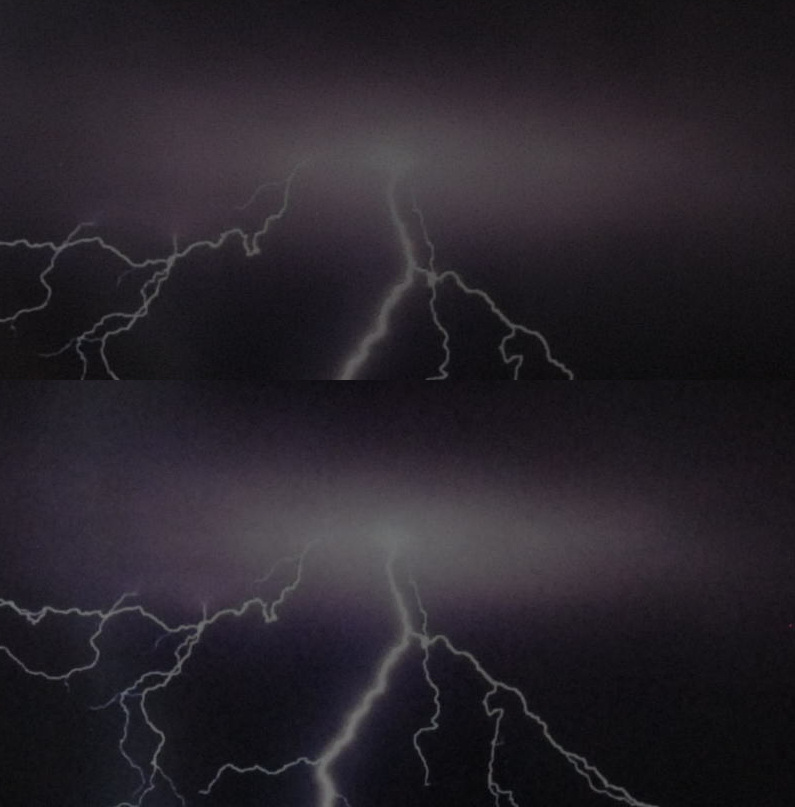
I did a poor man’s experiment to see how well very high ISO values of the D3 compared to my D200.  I was blown away.  The end result was that I was getting 640 ISO (from the D200) performance at around 3200 ISO!!  This is in the territory of 2 to upwards of 3 stops performance improvement in noise handling!  


In the example above, I photographed one of my large prints to use as a gauge for noise.  The top half of the image is shot with the D3 at an ISO setting of 2000.  In the bottom half, I shot with the D200 at an ISO setting of 640.  The noise on the D3 is quite a bit finer, which is easier to clean up.   More thorough reviews/tests of the D3 High ISO performance can be found below:

http://ishootshows.com/2008/01/07/impressions-on-the-nikon-d3-high-iso-performance/

http://www.kenrockwell.com/nikon/d3/vs-5d-180mm.htm 

June 13, 2008

Nikon D3 examples (part II)

Filed under: Photography — Mike U @ 5:22 pm

All about speed! 

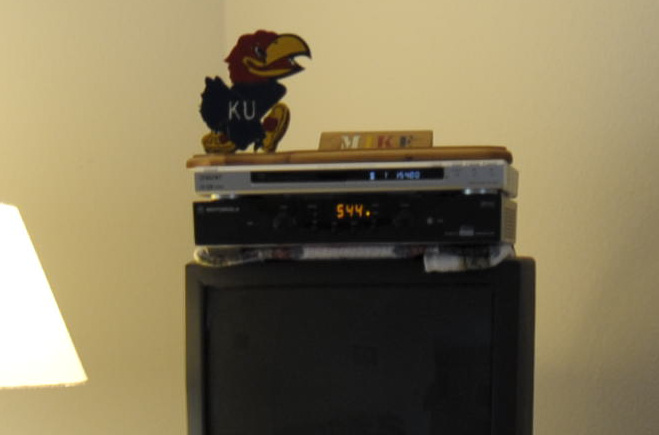
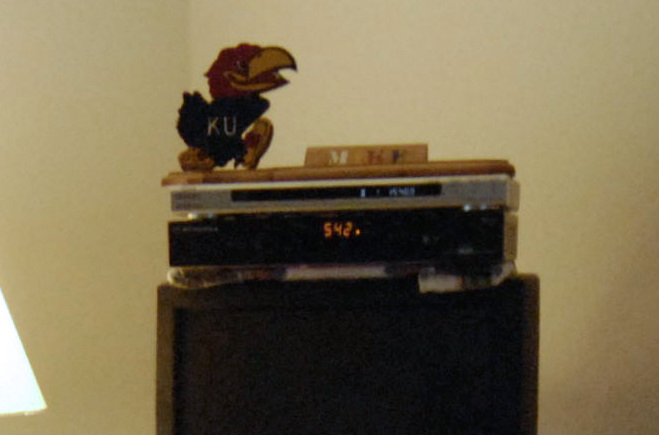
Here is an example of two images of the same scene — The first is with the Nikon D3 and the 14-24mm f/2.8 lens at full wide angle.  The second image is with the Nikon D200 and the 12-24mm f/4 DX lens, also at full wide angle.  The test here is to demonstrate a similar shooting situation in a low lit storm environment and you couldn’t set up a tripod.  These are both handheld, both shot at the minimum possible exposure for handheld without getting destructive motion blur (usually the ‘rule of thumb’ for minimum hand-held shutter speed is the reciprocal of the focal length of the shot… i.e. for 14mm lens, about 1/15s exposure).  In the two shots, I tried to create the same exact exposure image with "reciprocal of the focal length" shutter speeds:

The two images below are 15% of the full size, embedded JPEG file from the RAW (using DCRaw to retrieve the JPEG)


Nikon D3 with Nikkor 14-24mm f/2.8 @ 14mm.  1/15s, f/2.8, ISO 400. 


Nikon D200 with Nikkor 12-24mm f/4 DX lens @ 12mm (18mm virtual focal length).  1/20s, f/4, ISO 1250


This is a 100% crop showing the more detail of the first image with the D3 + 14-24mm f/2.8.


This is a 100% crop showing the more detail of the second image with the D200 + 12-24mm f/4. 

Obviously, the first image is much cleaner thanks to the lower ISO.  This is due to the lens, not really the camera.  The next test in part III will be an ISO side-by-side comparison using the same lens on the D3 and D200.  This will give me an idea how far I can push the ISO out in the field to my liking.

Nikon D3 examples (part I)

Filed under: Photography — Mike U @ 4:26 pm

Below are some examples comparing Nikon D3 + Nikkor 14-24mm lens with Nikon D200 + Nikkor 12-24mm DX lens.  The Nikkor 12-24mm DX lens was built solely for Nikon DX SLR cameras (the smaller sensors).  This is a smaller lens, and it will only project to DX size sensors.  Now, a DX lens will still work on an FX digital camera, like the D3, but it severely limits the capability of using an FX camera.    

All the images below are 15% of the full size, embedded JPEG file from the RAW (using DCRaw to retrieve the JPEG) 


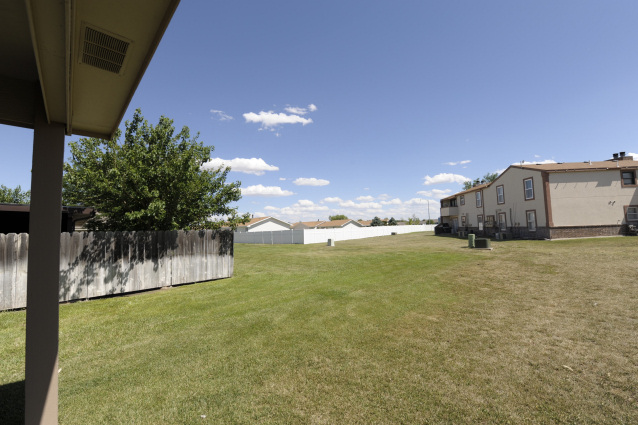
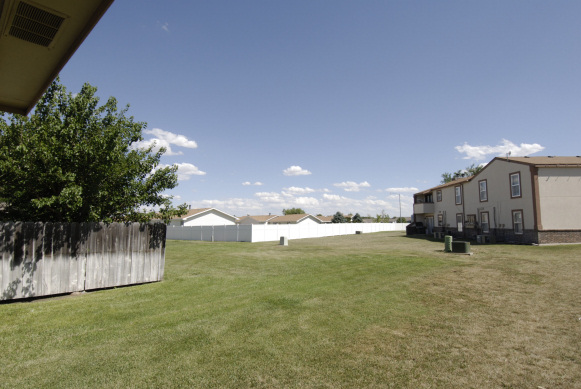
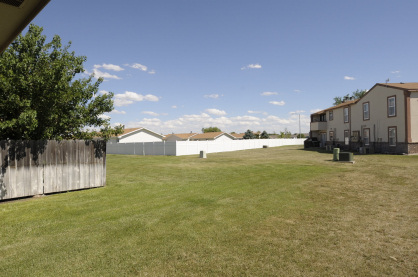
Nikon D3 with Nikkor 14-24mm f/2.8 lens @ 14mm.  1/640s, f/8, ISO 250, focal length 14mm


Nikon D200 with Nikkor 12-24mm f/4 DX lens @ 12mm.  1/640s, f/8, ISO 250, virtual focal length 12×1.5=18mm 


Nikon D3 with Nikkor 14-24mm f/2.8 lens @ 14mm, but this time I set the D3 to capture in DX sensor size, effectively turning the D3 into a ~6 megapixel camera.
1/640s, f/8, ISO 250, virtual focal length 14×1.5 = 21mm


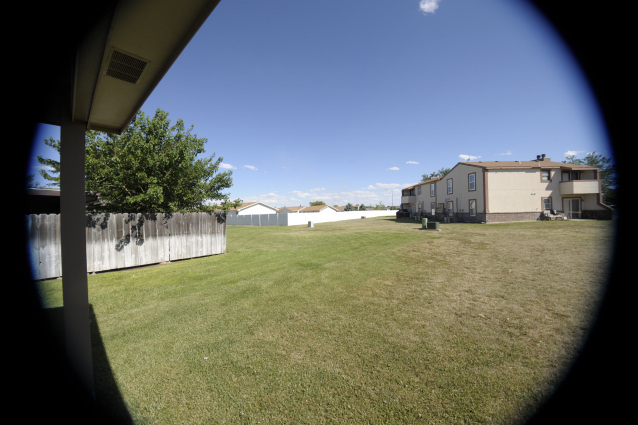
Now, here is what a DX lens (the 12-24mm f/4 in this example) would look like when used on an FX camera (Nikon D3 in this example) in FX mode!

To spin this another way — You would need a ~9.2-16mm on a DX camera to replicate the angles of view that this 14-24mm lens gives on FX and film cameras.

New Expensive Toys! >> Nikon D3 & Nikkor 14-24mm f/2.8 lens

Filed under: Photography — Mike U @ 3:58 pm

I believe I am set for quite awhile with this new equipment I most recently purchased from B&H Photo. I wanted to get the best of the best in terms of photographic speed and optics for storm/landscape photography.  After doing my research, I believe I now own the very best Nikon currently has to offer in terms of super wide zoom + speed + optics.  The Nikon D3 is a tank, but man what an awesome piece of equipment.  Yes, it cost $5,000 dollars, but this camera is incredible.  After some of the reading I’ve done and some of my own very preliminary tests… I now have the freedom of shooting in the ISO 1000 to 2000 territory without having to worry about doing serious "noise reduction surgery" to the final images.  The Nikon D3 is a "full frame" sensor, which means no more 1.5x crop factor.  All digital SLR sensors, except for the high-end professional cameras, have ~ 24x16mm sensors.  Full-frame sensors on the new professional SLRs have sensors ~ 36x24mm.  Obviously, this is more surface area for a lens to project light to.  What this basically means is a lens labelled as, say 18mm focal length, will have no "crop factor", your image will truly be 18mm.  On a DX camera (I’ll use "DX" and "FX" which is Nikon’s lexicon for the smaller digital sensor vs. the full frame).  You’d have to multiply 18 by 1.5 to get the resultant "virtual" focal length, which in this case would be 27mm.  That is the first reason why I wanted to by the Nikon D3. 

The 2nd reason is speed in capturing light.  Allow me to explain.  All the big hoopla these days is how many megapixels a camera might have.  That’s all well and good, and yes, more megapixels = greater resolution and larger possible print sizes of images.  The problem is, if you cram too much resolution to a DX sensor, you introduce greater sensitivity to noise.  The size of a pixel of captured light on the sensor becomes smaller, thus you’d need greater exposure time to decrease the probability of introducing noise.  It’s a pretty simple concept really.  Okay, so to resolve this, professional line Nikon and Canon cameras introduced full-frame sensors so that they can increase the megapixel count without having serious noise problems.  The Nikon D3 is "only" a  12 mega-pixel camera, but it is a 12 megapixel camera on a FX sensor, which means a much greater surface area per pixel for light to hit.  This is a far less sensitive sensor to noise, which basically means you can set the ISO value (camera sensitivity) to values typically not thought of for serious amateurs/professionals, including myself!  This is why the D3 is a fast camera.  It captures light faster than any other dSLR on the market because of the design of the sensor — the fact it has a great sensor size/pixel ratio.  

There’s nothing like matching fast with fast.  My primary lens on the Nikon D3 will be the 14-24mm f/2.8 Nikkor. ($1600).  This lens is also a tank, given its very large aperture at f/2.8.  For storm photography, this is excellent.  Obviously, many storm images are taken in low light environment, whether it be the storm itself making it darker or the storm occurring late in the evening (although usually both!).  Many times as well, these storms are on the move, and there are many instances where there is little time to set up a tripod, so one must resort to hand-held images.  With handheld, you have to watch your shutter speed.  The faster the lens/camera combination, the greater your chances of not having to have to resort to low shutter speeds to capture an image while on the move.  A fast combination like this is also great for situations where one might wish to get long exposure images of storm structure after sunset, but do not want any motion blur (or very little).  There are situations where it’s great to have super long exposure motion blur of clouds, but there are other times when it is not, as well.  Super wide and super fast is what serious storm photographers need out in the field.  The next post will be some image examples comparing the D3 with my D200.

June 11, 2008

Chase Acct: June 10, 2008 (SW KS Bust!)

Filed under: Chase Accounts,Storm Chasing — Mike U @ 9:08 am

I’m not going to make this a very long post… but I’ll at least document this unfortunate chase.  Tuesday, June 10th was a day off work, and I was rather excited about the possibilities of playing with my new toy (more details in the next blog post!!) the very first day I got it.  All along, it appeared that it would be one of these marginal days for storm initiation, and if a storm went up, it would probably be all by itself, or at the very least, be some 200 miles away from the next storm.  My target for this happening was Southwest Kansas, probably not too far from Dodge City.  That isolated storm did indeed happen…. in North-Central Kansas!  Needless to say, I never made it up there, and all I could see was this tremendous back-sheared anvil way up on the northeast horizon.  This is a bust that is rather painful because I knew something like this would be extremely photogenic — tornado or not.  There were probably a handful of chasers on that storm, and only one SpotterNetwork car made it up there and that was Charles Edwards.  He actually blasted north from south of Dodge City early enough to get up there just in time before the last of the daylight.  Meanwhile, after the first Liberal storm initiated and struggled to survive — only ultimately to choke to death on the cap, I continued west in dire hope that another storm could form on the retreating dryline.   It never happened.  I ended the chase and drove back home, taking the long way… north to Garden City on US-83 then back east-southeast on 50.  I met up with Greg Stumpf and Steve Hodanish who were staying in Dodge — they also busted in the same area, so I wasn’t alone.  You win some, you lose a lot more ;-)

Here’s a StormLab screen capture from during the chase.  Note my position no where near that big red storm.  I’m at the bottom left between Garden City and Dodge City.  D’oh! 


June 5, 2008

Chase Acct: June 2, 2008 (WY-NE-CO Border)

Filed under: Chase Accounts,Storm Chasing — Mike U @ 10:27 am

June 2nd was the last of my 3-day mini-chase trip.  I started the day in Ogallala with Matt Crowther, Greg Brenneman, John Moore, and the "Original" Twister Sisters (Linda Kitchen and Kathy Velasquez).  Our target was west on I-80 near Sidney in anticipation of storms forming off the Laramie Range to the west.  There was a bunch of low clouds and light fog/drizzle to start the day across much of the Nebraska Panhandle, and this lingered through about midday before finally clearing off.  I parted ways with Matt’s group at Kimball, deciding to head west to the Wyoming border to monitor the first significant tower going up northeast of Cheyenne.  This first tower amounted to pretty much nothing.  I sat and waited awhile north of Pine Bluffs as weak showers/storms continued to develop around Cheyenne and points north…amounting to very little excitement.  The evening hours were waning fast and I was beginning to think this was going to be a bust.  I optioned back south closer to Pine Bluffs and continued to monitor, as I failed to give up hope.  I had a strong feeling decent storms would develop given the continued model forecast of strong convection developing in this area.

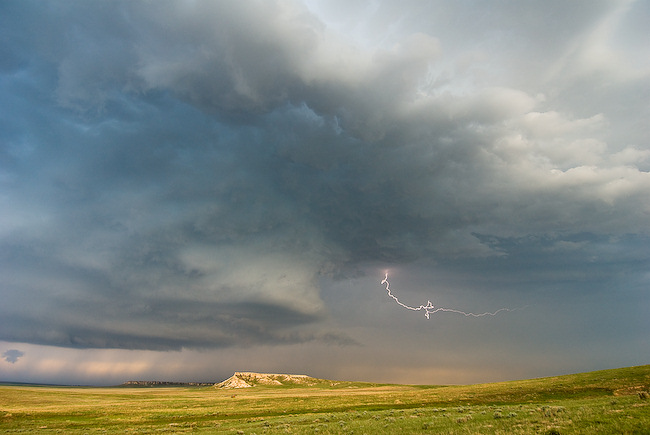
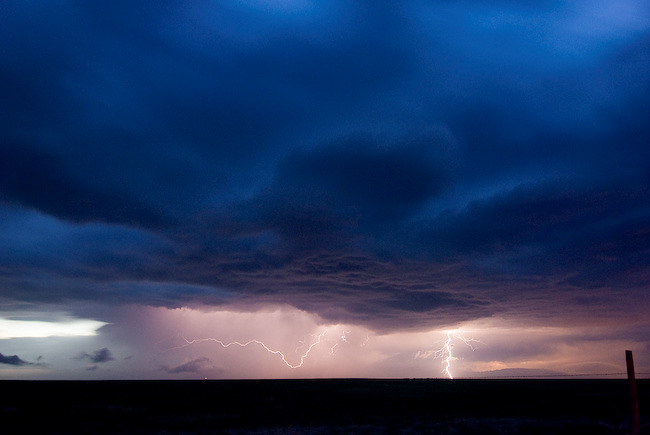
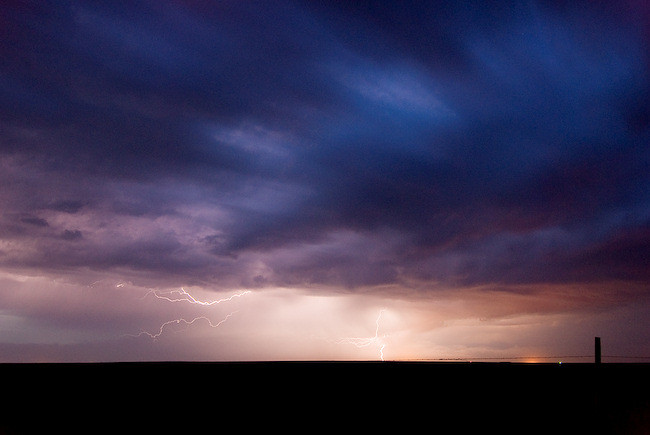
A supercell finally formed off to my southeast, and I bolted west on I-80 to a south option about 8 miles west of Pine Bluffs.  The storm showed some pretty good structure once I got far enough south.  I followed this storm east and south on unpaved county roads through the Pawnee National Grassland.  I stopped at a location east of Grover where I had a neat landscape with a few buttes in the landscape with the storm off in the distance to the north.  I managed to get a couple of cloud-to-cloud lightning images with the storm structure and the landscape with the Lightning Trigger.   I tried to get east of the main updraft area, but wasn’t having much luck.  A new severe storm was forming northwest of me, and I decided to wait for it for some more lightning images.  I photographed some long exposure structure + lightning for awhile in the southern part of the Pawnee National Grassland (north of Raymer).  I finally called it a chase at around 10pm mountain time, and headed south to Brush for the night.


June 2, 2008

Chase Acct: June 1, 2008 (Nebraska Panhandle)

Filed under: Chase Accounts,Storm Chasing — Mike U @ 8:18 am

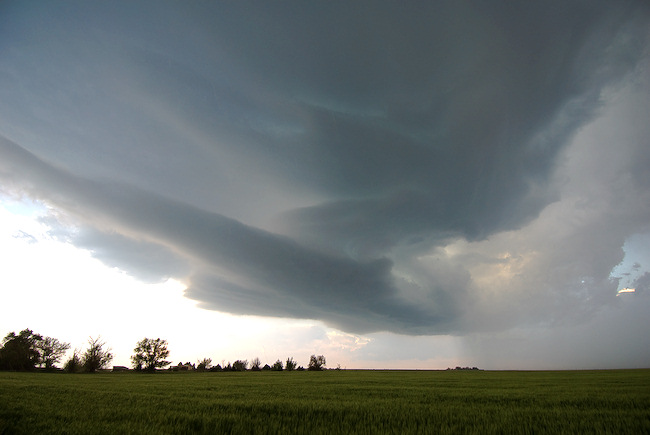
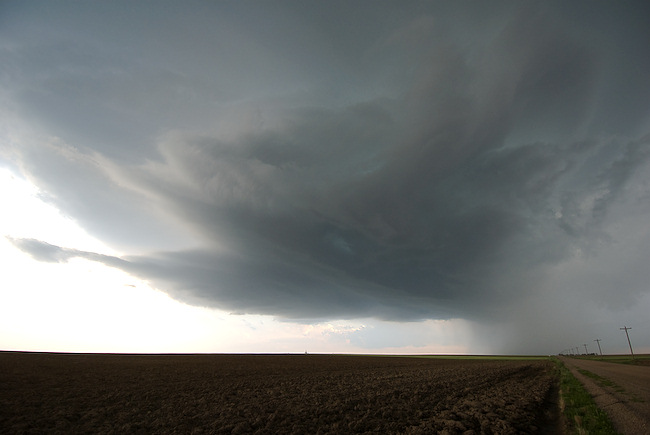
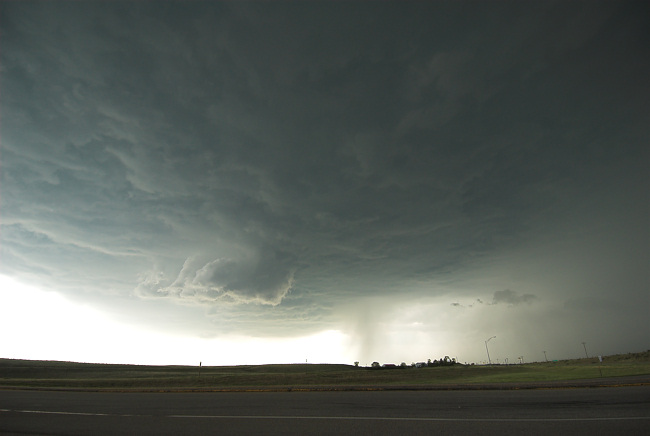
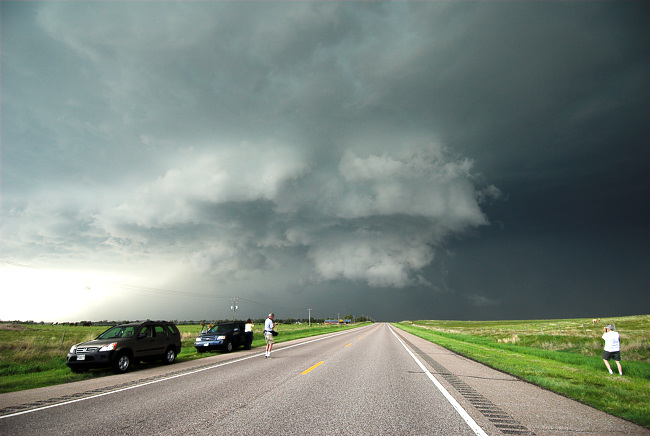
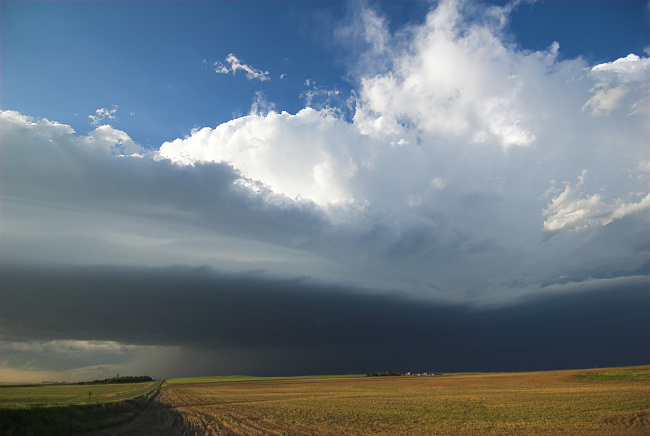
Sunday, June 1st was a pretty good day for storm photography.  I targeted the far western Nebraska Panhandle, arriving at a location north of Pine Bluffs, WY by mid-afternoon.  Storms first formed off the Laramie Range and struggled for quite some time.  Finally, a cluster of severe storms formed just north of where I was positioned along Hwy 88 over far northwest Banner County, NE.  Ultimately, a supercell was spawned out of this cluster northwest of Bridgeport.  I repositioned myself to the southeast of Bridgeport after driving briefly through the core of the storm at Bridgeport, receiving 1" diameter hail.  I met up with Matt Crowther, Greg Brenneman, and the "Original Twister Sisters" at the junction of Hwy 385/92 southeast of Bridgeport.  I was greeted to a moderately rotating wall cloud to the immediate west southwest with dust being kicked up from the RFD.  We followed this supercell to the southeast across a gridded dirt road network between Hwy 26 and I-80…east of Hwy 385 (northeast of Sidney).  The storm had too much cool RFD air thanks to the high-based nature of the storm, but the structure was quite nice.  When I reached Chappell, I continued south for photography opportunities from afar.  The storm looked fantastic from the distant southwest.  I photographed the storm from the distant southwest for the rest of the chase…while pretty much all the other chasers were up close.  The isolated nature of this supercell was ideal for more distant structure shots given the pristine blue sky around the storm.  I finally called it a chase about 17 miles SSW of Julesburg and drove up to Ogallala, NE for the night.


« Newer Posts

Powered by WordPress