High Plains Drifter


disclaimer:  "The meteorological views/forecast thinking expressed are those solely of the author of this blog
and do not necessarily represent those of official National Weather Service forecast products,
therefore read and enjoy at your own risk and edification!"

November 13, 2008

More Photos of 10 November Johnson, KS tornado

Filed under: Nov 10, 2008,Photography,Storm Chasing — Mike U @ 1:31 pm

Here is another photo of the Johnson, KS tornado at its mature stage.  The image was processed using mainly Levels in Adobe Lightroom and further processed using layers in Paint Shop Pro.  I used Neat Image to clean some of the noise up since I shot this at 500 ISO on my Nikon D200.  (My Nikon D3 is what I am currently using only for ultra-wide angle landscape/stormscape images, which is why all the tornado images were shot using the D200 so I could zoom in more).

There are more images!  I have uploaded an album of 22 photos showing the life of the this rare western Kansas November tornado 


November 7, 2008

UTM Photo of the Month — November 2008

Filed under: Photography,UTM Updates — Mike U @ 7:31 pm

Dramatic cloud-to-ground lightning flash with foreground traffic streak

Thisimage was one of several memorable keepers from a storm chase in Aprilof 2008. I was fortunate to observe and photograph one of the mostprolific "high quality" lightning producing storms I had seen in a longtime. I had the tripod set up between the east and west bound lanes ofa divided highway east of San Angelo and just so happened to capturethe streak of tail lights as a truck was traveling west. Details ofthis image: Nikon D200 body, 16mm focal length (24mm virtual focallength), 15s @ f/8, ISO 125. Photographed April 26, 2008 during a westTexas storm chase.


November 3, 2008

November 2008 update …on life :)

Filed under: Misc,Photography — Mike U @ 7:39 pm

Okay, time to get people caught up in the amazing wonders that is the life of Mike Umscheid and Underthemeso.com.

1.  Career move.  For those who didn’t already know, I was selected Lead Forecaster here at Dodge City, which is a pretty good promotion (responsibility wise and, of course, $$ wise).  What this basically means is that I will be here in Dodge City for the foreseeable future.  The ultimate goal of mine is to become a Science and Operations Officer at some point, but this is a 5-10 year time frame goal.

2.  SLS Conference and Greensburg.  I recently attended my first AMS Severe Local Storms Conference in Savannah, GA.  This was an excellent conference with an opportunity to learn quite a bit from the research community.  There is a lot of numerical modeling/simulation studies going on right now.  Wow.  Everything from simulation of observed supercells on 1 km grids to simulating corner flow regions of tornadoes on 10 to 50 m grids to very interesting simulations of tornado "debris swirl" patterns.  With increased computing technology, simulations of supercells and tornadoes will continue to become more  complex with better physics, microphysical processes, etc.  

I had been working feverishly on a conference paper with Les Lemon over the past couple of months on the "extremes" of the Greensburg storm.  This paper is online on the AMS conference website. It’s a 19-page paper that is really not all that far off from being ready for peer-reviewed publication submission.  Here is the URL… http://ams.confex.com/ams/pdfpapers/141811.pdf

3.  Photography.  Several Sundays back (the beginning of October), I gave a presentation on storm chasing and photography to the Consortium of College and University Media Centers annual conference which just so happened to be held in Lawrence, KS this year.  I gave about an hour presentation/slide show to the group.  I was surprised by the number of folks in the audience who had actually seen a tornado — more than half the room rose their hands.  At any rate, it was great to share my photography with a bunch of people who had probably never seen these kinds of storms even in picture before.  Later on that week, I gave a shorter version of this presentation at the Central Kansas Photography Club in Great Bend.  I met some more great people here, and I want to thank Jim Glynn for sharing with me all his incredible wildlife images as well as buying me dinner and the invitation to speak.  

4.  Speaking of Photography…  I haven’t done a whole lot of "field work" recently.  I did do a sunrise/early morning shoot at Big Basin the morning of October 24.  Interspersed in this post are a couple of images from that shoot.  The herd of bison that roam Big Basin Preserve offered some close-up shots as they straddled the rocky road on my way out.   The late afternoon/evening of Sat, Nov. 1 I went out to Quivira, but had disappointing results.  Crane numbers are not all that high (yet), and no Whoopers were to be found, despite there being sightings apparently earlier in the week prompting the signs throughout the refuge and notice on the QNWR website.  I don’t even have any images worth uploading I had such poor luck.  I wasn’t really in the "spirit" of landscape photography that evening either given the absence of clouds to help accentuate landscapes.  Perhaps this upcoming Saturday, Sunday, or Monday morning I’ll head out there for a morning shoot.  


October 6, 2008

UTM Photo of the Month — October 2008

Filed under: Photography,UTM Updates — Mike U @ 8:37 pm

Below you will find the new monthly installment of "UTM Photo of the Month".  For this month, I selected something from the archive:


Dawn at Artist Point, Yellowstone Canyon — Yellowstone National Park

This was one of many memorable photographic moments during my Fall of2006 trip to Yellowstone National Park. Artist Point is a famousphotography spot at Yellowstone, and I was hoping for wonderful softlight just prior to sunrise. I was more than pleased with what I got,which was a few high cirrus clouds lit up in a vivid, saturated pinkcolor to complement the extraordinary landscape of the Yellowstonecanyon and Lower Falls of the Yellowstone River. Date: September 19,2006. Exposure was f/9 at 1/5 seconds, ISO 200, shot with the Nikon D70at a 24mm focal length.


September 8, 2008

UTM Photo of the Month — September 2008

Filed under: Photography,UTM Updates — Mike U @ 10:10 am

Once again I am a little tardy in getting the latest image-of-the-month updated, but here it is!


Mammatus-filled eastern sky in the wake of a summer supercell across Southeast Colorado

Landscape photographers are always in search of that perfect "goldenhour" light. Much is the same for storm photography. The saturated softlight offered by the setting sun greatly enhances the mood of a scene,and when a dramatic sky is added to the mix, it can be an almostspiritual experience. After a big High Plains storms at sunset,photography opportunities are many times limitless. Details of thisimage: Nikon D3 body, 14mm focal length, 1/1600s @ f/5, ISO 400.Photographed August 12, 2008 during a southeastern Colorado storm chase.


August 10, 2008

UTM Photo of the Month — August 2008

Filed under: Photography,UTM Updates — Mike U @ 11:31 am

A little late in getting the August image of the month up, but here it is! 


Summer thunderstorm across a Northwest Kansas cornfield.
Saturated soft light certainly embodied this scene as a summer thunderstorm developed north of Colby, KS with a green cornfield and distant farmstead completing the scene. The precipitation shaft revealed wonderful contrast with amazing hues of blues and greys. The muted whites of the precipitation shaft indicate hail. Details of this image:Nikon D3 body, 14mm focal length, 1/50s @ f/11, ISO 1250. Photographed July 17, 2008 during a western Kansas storm chase.


July 7, 2008

Nikon D3 & Night Sky Photography

Filed under: Photography — Mike U @ 11:56 pm

A test of super-ultra long exposure with Nikon D3.  After work on Sunday night, July 6th, I decided to drive south to my favorite nearby photography location — Big Basin Prairie Preserve.  I wanted to give the Nikon D3 + 14-24mm f/2.8 lens combination a try in some really low light conditions — the night sky.  I really was curious to try a super-ultra long exposure (greater than 30 minutes) to see how the sensor noise was leaving the shutter open for so long.  Digital imaging sensors will accumulate "hot" pixels the longer the shutter is left open.  As technology has improved in digital imaging sensors, the duration one can leave the shutter open without introduction of noise has greatly improved over the years.  I remember my very first digital camera was a point and shoot Nikon Coolpix 950.  You couldn’t take 8 second exposures without introducing all sorts of horrible "hot" pixels dotting your image.  When I then got my first digital SLR (Nikon D70) one of the first things I noticed was the absence of hot pixels at 8 to 30 seconds!  They were absolutely clean of noise at low ISO.  That being said, image sensor noise ("hot" pixels) started showing up at super long exposures of 5 to 10 minutes.  Also, this thing called "amp glow" also started showing up in the form of a pink blotchy area at the corner of a frame due to the sensor heating up.  Internal camera digital noise reduction can eliminate much of this by a simple technique called frame subtraction (whereby taking another black-frame exposure of the same time length and subtracting that from the original image).  The only kind of photography really needing this kind of long exposure is star trail photography, which require 30 minutes to 3 hours worth of exposure time, depending on how much trailing you are interested in for your shot.  

Along comes the D3.  I was really curious how long I could keep the shutter open on this camera before the hot pixels and/or "amp glow" became too much of a problem.  On the old D70 I had, the amp glow started really becoming a problem at about 8 to 10 minutes exposure time.  Below are two versions of the same image from the D3 I shot last night with a shutter speed of 3,650 seconds (1hr, 0min, 50sec).  The first is the processed version adjusting the exposure compensation, levels/curves, noise reduction in Adobe Lightroom:


In the 2nd image, which is unprocessed, you can barely pick out the slight purple-ish hue at the very bottom of the frame.  You really have to look closely, but it’s there.   This is a ONE HOUR exposure, and you have to squint to find the amp glow.  I think Nikon finally got it right with the D3 and hot pixel/amp glow digital sensor issues for exposures longer than 10 minutes.  Some of the star trails, though, have some holes in them, as if it wasn’t exposing properly for a bit during the one hour.  I can’t entirely explain what was going on there.

But here is what really excited me…

Milky Way looking south.  Nikon D3, 14-24mm f/2.8 lens @ 14mm.  Exposure 99s @ f/2.8, ISO 1250 


I couldn’t believe the detail I was able to capture here.  Of course, the artificial lighting on the horizon was a bit of a pain, but given this shot, I am excited to get out on another clear, moonless night absent of any horizon lights to shoot the Milky Way again.  A full album of images from last night (just 7 images), is available. 

Mike U 

June 14, 2008

Nikon D3 examples (part III)

Filed under: Photography — Mike U @ 12:00 pm

Incredible High ISO Performance!

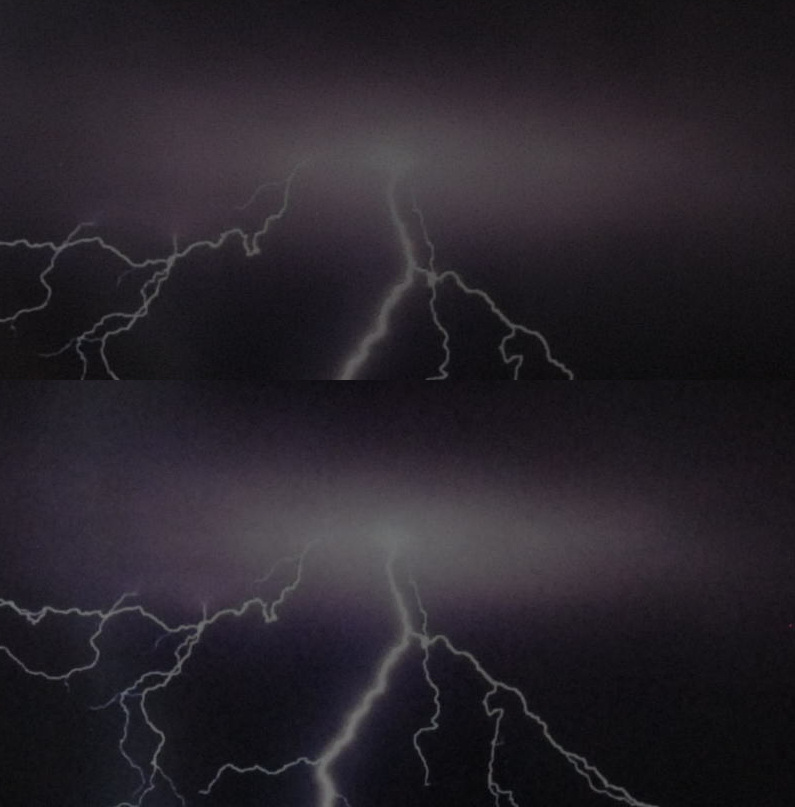
I did a poor man’s experiment to see how well very high ISO values of the D3 compared to my D200.  I was blown away.  The end result was that I was getting 640 ISO (from the D200) performance at around 3200 ISO!!  This is in the territory of 2 to upwards of 3 stops performance improvement in noise handling!  


In the example above, I photographed one of my large prints to use as a gauge for noise.  The top half of the image is shot with the D3 at an ISO setting of 2000.  In the bottom half, I shot with the D200 at an ISO setting of 640.  The noise on the D3 is quite a bit finer, which is easier to clean up.   More thorough reviews/tests of the D3 High ISO performance can be found below:

http://ishootshows.com/2008/01/07/impressions-on-the-nikon-d3-high-iso-performance/

http://www.kenrockwell.com/nikon/d3/vs-5d-180mm.htm 

June 13, 2008

Nikon D3 examples (part II)

Filed under: Photography — Mike U @ 5:22 pm

All about speed! 

Here is an example of two images of the same scene — The first is with the Nikon D3 and the 14-24mm f/2.8 lens at full wide angle.  The second image is with the Nikon D200 and the 12-24mm f/4 DX lens, also at full wide angle.  The test here is to demonstrate a similar shooting situation in a low lit storm environment and you couldn’t set up a tripod.  These are both handheld, both shot at the minimum possible exposure for handheld without getting destructive motion blur (usually the ‘rule of thumb’ for minimum hand-held shutter speed is the reciprocal of the focal length of the shot… i.e. for 14mm lens, about 1/15s exposure).  In the two shots, I tried to create the same exact exposure image with "reciprocal of the focal length" shutter speeds:

The two images below are 15% of the full size, embedded JPEG file from the RAW (using DCRaw to retrieve the JPEG)


Nikon D3 with Nikkor 14-24mm f/2.8 @ 14mm.  1/15s, f/2.8, ISO 400. 


Nikon D200 with Nikkor 12-24mm f/4 DX lens @ 12mm (18mm virtual focal length).  1/20s, f/4, ISO 1250


This is a 100% crop showing the more detail of the first image with the D3 + 14-24mm f/2.8.


This is a 100% crop showing the more detail of the second image with the D200 + 12-24mm f/4. 

Obviously, the first image is much cleaner thanks to the lower ISO.  This is due to the lens, not really the camera.  The next test in part III will be an ISO side-by-side comparison using the same lens on the D3 and D200.  This will give me an idea how far I can push the ISO out in the field to my liking.

Nikon D3 examples (part I)

Filed under: Photography — Mike U @ 4:26 pm

Below are some examples comparing Nikon D3 + Nikkor 14-24mm lens with Nikon D200 + Nikkor 12-24mm DX lens.  The Nikkor 12-24mm DX lens was built solely for Nikon DX SLR cameras (the smaller sensors).  This is a smaller lens, and it will only project to DX size sensors.  Now, a DX lens will still work on an FX digital camera, like the D3, but it severely limits the capability of using an FX camera.    

All the images below are 15% of the full size, embedded JPEG file from the RAW (using DCRaw to retrieve the JPEG) 


Nikon D3 with Nikkor 14-24mm f/2.8 lens @ 14mm.  1/640s, f/8, ISO 250, focal length 14mm


Nikon D200 with Nikkor 12-24mm f/4 DX lens @ 12mm.  1/640s, f/8, ISO 250, virtual focal length 12×1.5=18mm 


Nikon D3 with Nikkor 14-24mm f/2.8 lens @ 14mm, but this time I set the D3 to capture in DX sensor size, effectively turning the D3 into a ~6 megapixel camera.
1/640s, f/8, ISO 250, virtual focal length 14×1.5 = 21mm


Now, here is what a DX lens (the 12-24mm f/4 in this example) would look like when used on an FX camera (Nikon D3 in this example) in FX mode!

To spin this another way — You would need a ~9.2-16mm on a DX camera to replicate the angles of view that this 14-24mm lens gives on FX and film cameras.

« Newer PostsOlder Posts »

Powered by WordPress