
Preliminary Images:


Fast-moving HP Supercell at Shallow Water, Kansas
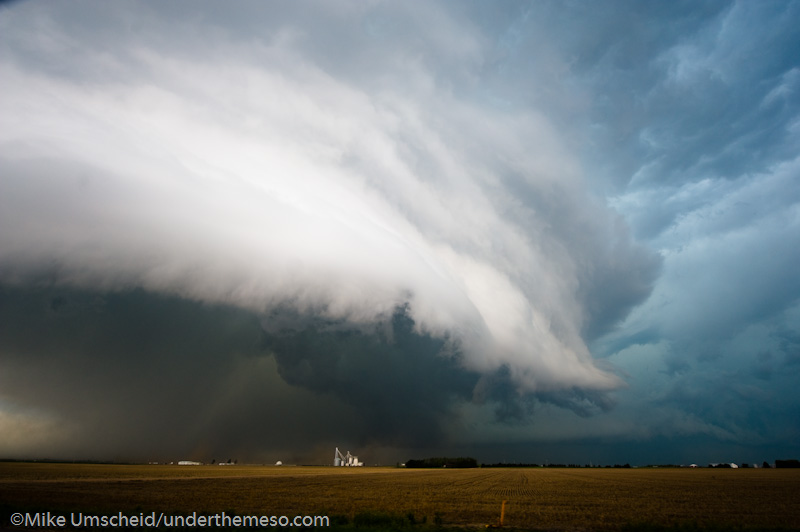

May 10th was the much advertised and much hyped (for good reason) tornado outbreak across the plains from southern Kansas into Oklahoma. Since I was still on my 10pm to 6am shifts, I was on a tight leash, so I couldn’t venture far from Dodge City if I wanted to chase. There was a target close to home with storms most likely developing by midday or shortly thereafter given the degree of forcing coming out with the compact upper low moving into southwest Kansas. By late morning, there was an axis of instability developing across far west central and southwest kansas as the stratus was slowly eroding away at the western edge. It was this corridor of instability where I focused my efforts on. After about three hours of sleep, I woke up to find things on target for the most part. My chase target was northwest of Garden City for the incipient storm development… and points northeast from there as the afternoon grew on.
I left Dodge City at 11am and headed north to Ness City then west toward Dighton. By 12:30pm, convection was forming in the drier air between Lamar and Syracuse which was moving northeast toward the Hwy 50 corridor and the Syracuse area. Radar was showing an east to west boundary developing and there appeared to be a convergence of fine lines on radar near the Garden City area. I decided to drive south into northern Finney County and watch things unfold to my southwest. As I got into clearing skies, the convective towers were obviously quite evident… including one to my distant south-southeast. The cluster of disorganized showers and thunderstorms to the west-southwest were about to enter the higher moisture content around 1:00pm, but it was also cooler, which was a problem. There just didn’t appear to be a whole lot of clearing farther to the east to widen the axis of instability for potential tornadogenesis. By 1:30, storms finally increased in intensity west of Lakin, and this activity was moving northeast which would approach Hwy 83 between Garden City and Scott City, so I made my way west to Hwy 83.

When I reached Hwy 83, I was greeted to a massive updraft area to my southwest. Tornado warnings were issued for storms farther north in the Leoti area. It turned out that there was a small cluster of non-supercell, landspout tornadoes. Oh well. I drove north on Hwy 83 to Shallow Water when the storm to my southwest was wrapping up significantly. This was turning into an HP beast, and I found myself in the notch of this thing. I got out of the car to take a few images, but I couldn’t do that long, as this storm was racing northeast at 50 mph.

As I drove north through Shallow Water, the structure to my southwest was fairly impressive with a nice circular, striated updraft area with a low-contrast lowering wrapping in rain to my west-southwest. Meanwhile, the wet RFD was racing north toward me fast. I made it to Hwy 96, but about 4 to 6 miles east of Scott City, I was being buffetted by 60 mph south winds in the RFD. This was really the beginning of the end of the excitement of this particular chase. The storm quickly became an outflow dominant mess as I was continuing east toward Dighton. I had some thoughts of just heading on home, but renewed updraft development on the old rear-flank gust front, which was now the leading edge of the synoptic dry intrusion, kept me just interested enough to continue following it. I followed it to Utica and eventually Ransom in northern Ness County along Hwy 4. There was a new mesocyclone to my southwest…

…and shortly after 3:00pm or so, there was a report of a tornado with this circulation, however I never saw this. Later on, I did see some photos of this feature, which was indeed a small, brief tornado. Unless you were in the right spot, you would not have seen this (and I was not in the right spot plus I was driving while this was occurring apparently). Storms moving 40 to 50 mph just do not give you the necessary amount of time to figure out what’s going on, especially when chasing solo. Plus the fact, the cloud bases were so low because the storm was moving into the area of low stratus that had stuck around all day up until that point. Not great conditions to photograph in. The best photography would actually be behind the storms looking at them from the southwest in the drier air. I entered Rush County and photographed some of the interesting convective underbelly of the storm in between the updraft area and the precipitation core. This was somewhat photogenic, especially with a green wheat field in front of me. This was around the 4:00pm time frame near McCracken.

I followed the storm as far east as the Hoisington-Russel longitude before giving up and heading back to Dodge City. I didn’t see any tornado on this outbreak day, but it was an interesting chase nonetheless.
11 images from this day’s shoot:
High-based storm & lightning near Grainfield, Kansas

(rest of images at the bottom of this post)
I was not expecting much on this day given dewpoint temperatures in the mid to upper 30s across much of western and central Kansas, however there were going to be storms based simply on the notion that temperatures in the mid levels…500 to 700mb… were still very cold. 500mb temperatures were going to be around -22 to -23C. The problem was that there wasn’t much of a focus for initiation to zero in and target on for chasing. Where was the best storm to photograph going to end up being? The environment looked equal just about everywhere from southwest Kansas into south-central Nebraska. I decided to use the RUC model as my guide as it was showing a corridor of southeast winds with a little bit better moisture… say mid 40s dewpoints… advecting back into west-central Kansas around Ness City perhaps. As it turned out, these winds never really materialized, and winds were quite light everywhere. The first storms developed farther north… north of Hill City, and this is where I was led. I made it to Hill City and eventually Norton, going after some briefly strong storms just into Nebraska near Alma. By the time I reached North I drove east to get into better position of these, but as I was doing this, those storms eventually waned with a bunch of other scattered weak convection developing to my southeast, south and southwest. Where to now? There was no need to be this far northeast when I could be a bit closer to home to photograph essentially the same convection. So I headed back southwest. I followed Hwy 9 west-southwest to Hwy 23 north of Hoxie as this areas was convecting better than any other, so I thought what the heck, I’ll just get closer to this stuff. I went south to Hoxie and eventually Grainfield when the “storm of the day” for me came into view to my southwest.
I wanted to get into a decent position for this cell, so I drove south on an unpaved county road southwest of Grainfield. I stumbled upon my shooting location of choice. A farm field with old corn stalks and an old barn making for a fantastic foreground subject. I used this old barn to my advantage — it certainly made the shoot! I set the D200 up with the lightning trigger and let ‘er go to work while I roamed around with the D3 to get some compositions of this old barn and the storm. I managed to get a few cloud-to-ground images from this storm with the barn off to the right. I think these compositions with the storm, lightning, and old barn work best as 2:1 crops in post-processing, which is what you’ll see in the album of images from this shoot. One of the frames even has me in the shot, which actually kinda works in a way for perspective! I felt pretty satisified with this and decided not to get greedy and begin my way back home. I went south on Hwy 23 to Gove only to find that it was closed south of Gove. I was forced to turn around and head back to I-70, but the next storm that developed in the cluster was producing some decent lightning frequency, so I gave it one more attempt to photograph just northeast of Grainfield this time along Hwy 23. I was at this location for probably 15 or 20 minutes before the lightning activity waned. At that time I decided to finally head on back to Dodge. This was exactly the kind of shoot I was hoping for, but honestly wasn’t expecting. I think one or two of the images from this day are Portfolio-worthy.
Begin: Dodge City, KS (home)
End: Dodge City, KS (home)
Day Nine Mileage: 431 mi.
Trip Mileage: 4085 mi.
13 images from this day’s shoot:
A dryline bust saved by late storm initiation on the cold front at Wilson Lake, KS.

(rest of images at the bottom of this post)
My target all along was the dryline just south of the cold front — somewhere from Great Bend to Pratt. I didn’t waver from this target, except briefly right after I had lunch in Hays when cumulus was already forming from west of Salina to east of Hoisington. I drove south from Hays after lunch, which pretty much sealed my fate for chasing the northern storms that 97% of the other chasers were chasing. Once I reached La Crosse, KS, I turned east to Hoisington watching the southernmost cumulus congestus to my east-northeast. Briefly, I thought this would be the intercept. I then noticed more aggressive cumulus growth to my south in my original target, so that was the clincher for me. I blew off that congestus to my east-northeast and dropped south from Hoisington. 1km visible satellite also confirmed this nicely with a clumping cumulus field centered across Stafford County and points south-southwest of there to between Greensburg and Pratt (4:30pm).

I made it down to Stafford which was where I decided to stage between 4:45 and 5:15pm. Nothing was happening with my cumulus field to the west through southwest… and I was becoming increasingly anxious. The best convergence on the dryline appeared to be shifting north a bit, so I moved back north and sat again along a farm road from about 5:30 to about 6:30. I spent most of this hour interrogating the models for the next couple of days of my vacation. Still nothing to my west through southwest. In fact, what cumulus was developing was quickly turning into a big area of virga. This wasn’t good!
The NAM and GFS models were insistent in vigorous convective development in the 00z (7pm) to 03z (10pm) time frame… right around sunset, with the southern edge of this vigorous development right about Great Bend. I felt very confident storms would eventually develop, but along the cold front instead. The cold front was slowly moving south toward the best dryline convergence. It was just a matter of time before initiation. In the meantime, I trudged north on farm roads (7:30pm), watching this huge area of virga shower activity from my northwest through southwest. You could make out some bases in spots, but nothing that said “come chase me” yet. It was just about to go. So I continued my merry way north (8:00).

Once I reached I-70 at around 8:30pm or so, the atmosphere finally let loose:

Intense development along the cold front all the way down to southwest of Great Bend! There were embedded mesos in spots along this line of convection, and the one I concentrated on was just west of Wilson Lake. There was a good view from Wilson Lake, so I decided to stop here and begin shooting. I was greeted to some insane inflow winds from the southeast! I estimated winds in the 50-60mph range… which was difficult to stand in, let alone to try and photograph in… or even set the tripod up (after all it was now 8:45 by this time and light was low!). Electrical activity was pretty good in the updrafts, and I managed to capture this to some degree in the stills. Since the activity was moving northeast instead of straight east, it allowed me to drive east and stay ahead of the storms… stopping for about 5-10 minutes to shoot, and then repeat. I continued east from Lincoln to Beverly. The best storm on the line now appeared to be to my southwest, so I headed south on an unpaved farm road from Beverly at around 9:45pm. This turned out to be a fateful move.
I blew out my front driver’s side tire. On a dirt road. With a storm to my west about a half hour away (10:05pm). I could still drive on the flat, but no faster than 20 mph. It was imperative I find pavement, and thankfully I was only 3 or 4 miles from an I-70 interchange west of Salina. I limped south and by a stroke of luck, one of the next east-west county roads was paved! I stopped here. Since this was a new Jeep that I had not changed a tire on before, I had to learn the little idiosyncrasies for spare tire changing with this vehicle on the fly… with a storm headed my way. I didn’t think I had any time before the storm hit, so I resorted to just photographing the damn storm updraft, since it was fairly photogenic…

The cell to my immediate west would miss me to the north, and I just got a few big rain drops (10:30pm) and it ended shortly thereafter. I had a brief window of opportunity to get the spare tire on before the next cell hit. That window was about 15 minutes…

…It took me longer than that to complete the job, because I started to get poured on shortly before 11:00pm. So now it was a waiting game… with my vehicle jacked up. So now I’m sitting in my Jeep with west winds gusting to about 60 mph rocking the Jeep a little bit while it was jacked up. I felt pretty confident that despite these winds, the jack would hold. And it did. So now I know I can have the vehicle jacked up in 60 mph winds, LOL. Not again, though. Next time, I will have it calculated down IN ADVANCE how long it takes me to change a tire. As much storm chasing as I do, this is the #1 reason for a break-down. A flat. It’s happened a number of times to me, my chase partner’s vehicles, or other chaser’s vehicles that I’ve assisted on. I had planned on doing a practice tire change before my trip, but I simply ran out of time preparing for my trip in other areas. It ended up biting me. But I got the job done. When this vacation is over, I’ll do another practice spare tire change and time myself so I know exactly how long it SHOULD take, if I’m chasing solo.
The rain finally let up enough to get out and finish the job at around 11:30pm, and I was back on the road. At this point, I was obviously done chasing given the time and the activity to my east, so I began my trek back to Dodge City.
Begin: North Platte, NE
End: Dodge City, KS (home)
Day Six Mileage: 620 mi.
Trip Mileage: 2847 mi.
20 images from this day’s shoot:
3 Supercells in the Nebraska Sand Hills — including memorable late-night moonlit supercell near Stapleton, NE

I was hoping for just some decent storm structure for maybe an hour or so around sunset on this particular chase day… trying to keep my expectations to a minimum. What resulted was one of the best storm photography moments I’ve had since shooting DSLR in 2005. I observed three supercells, two of which I photographed extensively during their mature phases. My chase day actually began in Thedford with a target of Ogallala in mind. I arrived in Ogallala with upstream dewpoints in the 45-46 degree territory at Imperial and McCook. I figured it would take about a 48 dewpoint to get a large area of ~ 1000 J/kg of CAPE. That eventually did happen, and my main area of interest was along and just north of I-80 where the highest dewpoints appeared to be advecting toward strongest low level convergence. This all seemed to be taking place just north of Ogallala. I drifted west from Ogallala to Big Springs where I observed a bunch of virga showers from southwest to northwest. I followed this junk east… sticking with it… because I’ve seen severe storms eventually be born out of this agitated high-based shower activity. I got to North Platte, and by this point it was going on 6:00pm, with still nothing much to write home about. I was becoming increasingly frustrated and was thinking this was going to end in a bust. Small updrafts to the northwest struggled mightily. That being said, there was still good south-southeast wind with 47 to 48 dewpoints feeding into this area of weak convection. Knowing that the upper level jet was just beginning to impinge on this area, I knew I couldn’t just simply give up at 6:20pm in the evening. Never do that unless it is totally obvious there will be NO STORMS at all! In the back of my mind, I was imagining that a) April jet stream, b) good low level inflow, c) dewpoints in the upper 40s, d) good low level convergence/frontogenesis… and thinking that this could possibly yield a surprise.
An elongated cluster of storms was increasing in strength south of Thedford, and I followed this northeast from North Platte to Stapleton where I headed east on Hwy 92 to Arnold. The lead storm to the northeast was initially the strongest, so I set after it first. Eventually, it died between 7:00 and 7:20pm or so. Then cell “Z1″ started to form at the southwest end of this cluster.

I was in great position for this. At Arnold I went north on a county road and got some of my first structure shots of this newly developing supercell. It was gaining on me fast, and since I wasn’t a fan of all the low clouds obscuring my structure view, I backtracked to the south to Arnold to get a little farther away from the cell again. I did manage to get a few images of the cumulonimbus tower above some of the low level inflow tails. Sunset was near as I made my way to Anselmo. I took more county roads north and east of Anselmo where I photographed an ominous lowering/wall cloud feature to the north, however the contrast was kind of poor. I did manage to capture a distant cloud-to-ground lightning flash with the lowering off to the left as the storm was beginning its demise. By 9:00pm, the storm was racing off to the northeast, north of Taylor and I let it go. At this point, I was satisfied that I got myself a supercell on such a marginal day and I was ready to call it a day and head to Kearney for the night.

But my chase had really only just begun.
I drove about 5 miles or so southeast of Anselmo on Hwy 2 when the next supercell formed to my northwest…northeast of Thedford. The distant structure on the horizon was too good to pass up. Problem was, I was so far away from this storm that I had to use a zoom lens on my D200, since I don’t have a fast, full-fame zoom lens on my D3 (I just have 14-24mm f/2.8 for my D3). I took a couple wide angle shots with the D3, but the storm was too far away that it didn’t really fill the frame at all. With the D200, I still use the 18-70mm lens which is only a f/4.5 at the focal length I was wanting to shoot at. The D200 does not perform well at ISO speeds greater than 640 either, so that is always my limit. Given that, I couldn’t do 6 second or less exposures to freeze the storm with what little astronomical twilight was left. I did get a few images, but I pretty much cut my losses and resumed my drive to Kearney… or so I thought. I then decided I wanted to look at the new NAM model for tomorrow’s chase forecast, which had just come in, so I pulled off the road to do a little model interrogation with IDV. A quick glance at the radar revealed yet another storm off in the distant west at around 9:45pm. Given my frustration with not being able to photograph that second storm like I was hoping, I felt like I had to redeem myself and get closer to this next approaching storm, since the lightning activity was increasing. The full moon had just risen, too, so I was thinking that this could get quite interesting, photographically.
I abandoned the idea of driving all the way to Kearney and though of North Platte instead, since a) it was closer and b) I was 90% sure I would be chasing in KS tomorrow. I drove east toward the approaching storm, which was now really looking good on radar, as well as visually with the lightning. The moon was also just about to appear over some clouds it had been hiding under. What proceeded after that… from about 10:15 to 10:45pm… was something truly spectacular. I found an adjacent farm road to Hwy 92 and pulled off with a great view of this supercell. Tall cloud-to-ground staccato flashes then began to occur. I couldn’t believe it! The tripod went up and I started firing away. I was closer to this storm, versus the 2nd storm about an hour earlier, so I could use the D3 with the 14-24mm lens and fill the frame with ultra-wide compositions. The results were nothing short of amazing. It was perfect. Everything about it. The supercell structure — clean with no other clouds blocking the view — some soft front light from a bright full moon. Standing in a farm field with NO powerlines, NO artificial lights as a distraction. No other chasers (except Dann Cianca farther west on SpotterNetwork). This sucker was over the sandhills! Wow!! And I had the right equipment to get the best images possible in this kind of light. I was able to successfully shoot 5 second exposure frames…. the whole time. Every single frame from this storm was 5 seconds. 5 seconds, f/2.8, ISO 800. ISO 800 on the D3 is extremely clean, and I would have felt comfortable shooting even higher, but there was no need to. The full moonlight was enough light with this fast equipment. Of course, lightning in the storm itself provided additional illumination. This was a dream come true! I have always wanted to shoot supercell thunderstorm structure illuminated by full moonlight. Oh yeah, and some of the cloud-to-ground flashes were quite spectacular too, coming out of this storm. I finally let the storm go around 11:00pm or so and made my way to North Platte for the night.

Begin: Thedford, NE
End: North Platte, NE
Day Five Mileage: 457 mi.
Trip Mileage: 2227 mi.
17 images from this shoot:
Weak showers, virga, and rainbow put on a display near Vaughn, New Mexico

The forecast worked out perfectly for Day One. My goal was to get photogenic New Mexico sky + landscape scenes from innocuous convective showers in an environment with prevailing northwest surface winds and CAPE of about 100 J/kg (LI around -1°C). My target was Las Vegas, NM and south of there once showers moved off the mountains. I arrived in Las Vegas, NM around 12:45pm MDT with some initial showers already forming just northwest of town. After a quick lunch I drove south on Hwy 84 toward I-40, stopping a few times to photograph a few of the showers to my north. I then continued southwest on Hwy 54 stopping a few more times along the way as the showers were increasing in coverage with more widespread virga and rain reaching the ground. The dewpoint was in the lower 30s, so there was a lot of evaporation of the precipitation cores. I reached Vaughn and drove a few miles southeast for another quick photo grab… then back to Vaughn to head south on Hwy 285, where I spent most of my time during this chase. 10 miles to the southeast of Vaughn, I found this ranch road called County Road 3G (per Tiger shape file readout). This was a nice little road away from the main highway a little bit to do some work without the traffic distractions of the highway, which is a 4-lane highway all the way from Vaughn to Roswell. More showers were developing off to the northwest, and as early evening was approaching, I was trying to figure out where the best opportunity to set up for “golden hour” light. I thought I was going to have to head northwest quite a ways for fears that the convection would hover too close to the western horizon and limit lighting possibilities from the setting sun.
First I drove west on Hwy 60 about 12 miles or so, then I realized that this wasn’t probably the best move, so I retraced back to Hwy 54 (from Vaughn you can travel in 5 different directions) and drove southwest thinking this might be the best path to sunlight. After about 8 miles driving on this highway, I began to reconsider this, too, for fears that the shower activity would be too far to the east without much convective virga/etc near me. About the time I decided to turn back around for Vaughn again, a rainbow started to appear. I photographed this rainbow as it waxed and waned periodically for a good half hour! I followed the backside of one particular shower as I drove south-southeast on Hwy 285. The rainbow was rather brilliant at times. I made it back to the aforementioned county road 3G where I had most of my best images, especially just before 7:00pm MDT when a large evaporating precipitation core lit up brilliantly on the backside of one of the showers to my southeast. A portion of the ever-persistent rainbow extended down from this virga shaft. I was fortunate enough as well to find a nice windmill for a foreground subject right next to the ranch road. I kept shooting for the better part of the next 40 minutes or so along this ranch road until the light finally faded. I managed to get one last grasp of pink color, looking off to the distant east as I was driving south along Hwy 285. All told, I probably stopped about 4 or 5 different times along Hwy 285 south of Vaughn during this chase… having to cross the 4-lane highway (which was sparsely traveled) in order to get to the east side of the road to set up and shoot. This was a very fun shoot!!
Begin: Dodge City, KS
End: Roswell, NM
Day One Mileage: 618 mi.
Trip Mileage: 618 mi.
23 images from this shoot:
first chase of the season — non-severe storms, Gove County, Kansas
My first attempt at a long-winded chase account was just erased after 30+ minutes of writing, and I’m not up to re-writing it… the upshot of it was that I chased quasi-linear multicell storms, of the non-severe variety, late in the evening on Thursday, April 15th. I intercepted the storms just northwest of Quinter before heading south again on various farm roads of eastern Gove County. The best images came around 8:15pm or so…
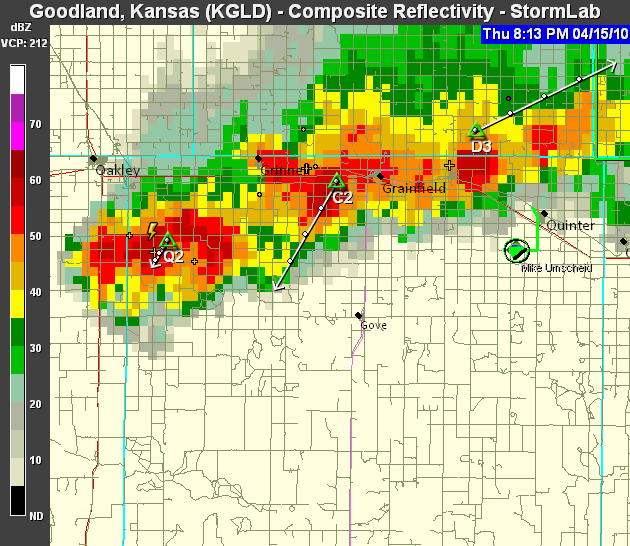
…around the time of sunset when I photographed beautiful colors with a cloud-base lowering present associated with the strong updraft (with cell “D3″ in the above radar image). After the colors waned, I headed farther south on more county roads approaching Hwy 4. The chase was pretty much over by that time as the storms had no more photographic interest due to weakening and no ambient light left. Images below! (NOTE TO SELF: next time, draft your write-up in Wordpad, not the WordPress blog post window!!! Ugh.)

…Woodward Late-evening Supercell…
(originally written August 20th for a storm chaser forum, slightly edited/uploaded to blog December 13th)
August 19th was a rather interesting day. After the tornado watch conference call with the Storm Prediction Center at work, shift was over and I left DDC at about 4:15pm and headed down to a clumping Cu field in Woods/Alfalfa county. When I first left, a nice hard tower was evident distant southeast and when I looked at radar and saw the blips wayyy the hell southeast close to Enid, I thought this was a fool’s errand. I got gas in Greensburg and contemplated heading home. I then noticed some agitated cumulus to my southwest. Observations showed southwest winds all around northwest OK… yet dewpoints were in the 65 to 67 degree range. Even with a southwest surface wind, there was still excellent deep layer shear across NW OK with the impinging upper jet streak from the northwest. It became clear as I was driving south toward Hwy 64 that the outflow boundary towers were just not doing it. I was rather surprised that I didn’t see atom-bomb city going on southeast. I wonder if there was a mesoscale gradient in convective inhibition (CINH) there that was just too much for the Enid towers as they were advected downstream to the east? Were these towers/plumes moving east or southeast? If they were moving due east, they would have crossed the boundary at a sharper angle and succumbed to the CINH faster… just not enough time to get that deep sustained moist convection process “jump started”.
These were the things that were actually running through my mind as I was watching this unfold from a distance to my southeast. Meanwhile, to my southwest, the boundary layer was deeper with lower 0-3km static stability and thus easier to “jump start” deep, moist convection. It’s all about initiation, and the direction of motion of towers once they initiate. Regarding that Enid area failed initiation, it just seemed to me that once plumes went up, they crossed the boundary and the strongly backed winds were doing a number on the “jump starting” process. Nice backed easterly winds are great once you have a well-established storm, obviously. What if the towers formed 20 miles farther west…such that they had more time to accumulate growth…before interacting with the higher CINH easterly flow east of the OFB? It could have been a much different story perhaps. I’m just thinking out loud here.
When I got to Hwy 64, I drove west and thought that I could get a good storm going around Harper-Ellis County, OK given the uniform lower static stability in the lower troposphere + CAPE still around 3000 J/kg. 800 to 1000 foot higher elevation also helps in this department for convective initiation… which is why I usually favor farther west for storm initiation. I’ve seen this song and dance before — fantastic looking soundings, good convergence, parcel theory suggesting CINH < 25 Joules… yet still nothing. In almost all these cases, there seems to be too sharp of a potential temperature gradient with initial storm motion vectors taking initial plumes into the cooler pot temps too quickly…and you just end up with anorexia.
Oh yeah, the northwest of Woodward storms were pretty photogenic. Saw a wall cloud at sunset northwest of Woodward, some incredible crepuscular rays radiating through a storm tower (the soon to be Woodward supercell)… there were actually two side-by-side initially. The images below show the initial towering cumulus stage with the northeastern storm developing a nice structure toward sunset. The western storm was the one that eventually took over to the northwest of Woodward, which is what the wall cloud images are from.
…Hailstorm, Rainbow, and a carpet of Sunflowers east of Greeley, CO…
I was very pleased with the outcome of this chase…despite the fact that the storm I followed was less than severe amidst dewpoint temperatures in the mid 40s east of Greeley, CO. This was the final day of a two-day chase, and I decided to make this day a chase day after interrogating model data early that morning. A very “cold” upper air trough for this time of year was still positioned across the northern Rockies with a smaller scale short-wave trough expected to rotate through southern Wyoming by afternoon. This would bring a shot of mid level cold advection with 500mb temps around -14C impinging on the Front Range by late afternoon. In this environment, even a surface parcel of about 77F over 45F dewpoint still yielded enough CAPE for a photogenic storm. You don’t need high CAPE for great storm photography in Colorado, especially with really good deep layer shear present — which was the case this day. I had a target around Limon initially, however I never made it down to the I-70 corridor. I drove southwest toward the Denver metro on I-76 instead.
I figured the best storms would be developing either right along the Front Range or just east. Given the depleted moisture from the prior night’s cold front, the best CAPE in return southeasterly flow would be banked up against the higher terrain. The drive down I-76 was interesting earlier in the day. Wildflowers… mainly wild sunflowers… were rampant. It was a very thick carpet of sunflowers in some of these fields for as far as the eye could see. It was a rather incredible sight — thanks to the wet spring and summer across the region. I drove as far southwest as Hudson, then west to I-25. By this time, a few weak showers dotted the Front Range from my southwest to west-northwest. A small storm was beginning to develop up near Cheyenne, which was quite visible from my location, so I drifted north on I-25 to position myself accordingly to keep this area in play — but I really didn’t want to pursue a storm that far north given the drive back I had to make to Dodge City. I drove as far north on I-25 as Wellington then east to near Nunn. I sat along a farm road between Wellington and Nunn for about an hour or so — becoming increasingly frustrated by how slow things were evolving. The showers off the mountains just weren’t cutting it — turning to garbage “virga bombs” as they rolled east toward me off the mountains.
After awhile, I became impatient, and the time was going past 5:00pm CDT. I was gettng hungry, so I stopped at a fast food joint and grabbed a quick dinner north of Greeley. Sure enough, taking my mind and eyes off the sky for a little bit did the trick! When I came out of the restaurant, there was a storm to my south-southeast…just exiting the northeastern fringes of the Denver metro. This was my target storm and I plotted an intercept southeast of Greeley following Hwy 34. After studying this storm for a bit both visually and on radar, it quickly became evident that this storm was a left-mover — in other words, the updraft region was on the north flank of the storm — and was moving quickly to the northeast. Given this, I needed to get north if I wanted to photograph the updraft region of the storm. I saw a county road on the map near the Riverside Reservoir — and it was a race against the hail core to get there. The northwestern fringes of the core reached me at the same time I reached my north option, so I had to blast north in order to stay ahead of it.
I drove north a good 7 or 8 miles before I get well enough ahead of the core, and by that time, most of the precip core was now going to be east of me as it tracked northeast. I found a spot to photograph the storm from looking east — another incredible field full of wild sunflowers! Incredible! The landscape, the distant hail core of the storm… all this color was just phenomenal. Then a partial rainbow formed, and the scene became even more spectacular! Wow!! I was having a field day tromping through waist-high wild sunflowers shooting this incredible scene. The ~ 15 minutes I spent at this one spot watching this sub-severe storm move away from me amidst this incredible field of yellow was well worth the two-day trip! No doubt about it.
This storm got away from me, but that was okay, there were more developing to pursue. I eventually went after a storm to my southwest, to the south of Keenesburg. I got ahead of this storm, which was the more traditional “right mover”, as the updraft region was on the south side. This storm was also sub-severe, but the updraft area was decently organized…although cloud-to-ground lightning was my main focus with this storm…and I managed to get a few images. I followed this storm until sunset east to Hwy 71 at Woodrow. It was a long drive back to Dodge City, arriving back home about 3:30am or so.
I was targeting the Sidney, NE area for supercell storms on August 15th. I left Dodge City early in the morning and made it to Sidney by around 2:30 to 3:00pm or so. The initial convection I was watching was north to northwest of Sidney, and I drove north to highway 26 at Broadwater. I had a decision to make: drive north on 385 to Alliance and follow the activity developing north of me…or head east-southeast toward a congested cumulus field closer to upper 60s dewpoints. I chose the latter — heading east-southeast to Lake McConaughy. An isolated storm developed northwest of the lake which was showing some interesting organized structure, but I could never find a good location to shoot this storm from as sunlight was really hampering photography opportunities… therefore I didn’t get any images of this storm. When I repositioned farther south, the storm vanished at the blink of an eye it seemed like. Even at this point, I still could have driven north to Arther and highway 92 area, but chose not to. In the end, the highway 2 corridor from Alliance to Hyannis to Thedford was the place to be this day — or on I-70 in northwest Kansas where an isolated supercell thrived away from the MCS I was chasing. The “butt” end of the linear storm complex I was only photogenic when the storms were northwest of the lake. I drove north on a sand road called Berry Road north of the lake off highway 92. The scenery was fantastic along this road! Below are a few images of the storms northwest of me from along Berry Road north of Lake McConaughy:
Powered by WordPress