High Plains Drifter


disclaimer:  "The meteorological views/forecast thinking expressed are those solely of the author of this blog
and do not necessarily represent those of official National Weather Service forecast products,
therefore read and enjoy at your own risk and edification!"

June 19, 2008

June Chase Trip 2008: Day 1 Summary (NW KS)

Filed under: Chase Accounts,Chase Trip 2008,Storm Chasing — Mike U @ 6:29 am

June 18, 2008 — Brief Supercell from Seldon to Quinter, KS 

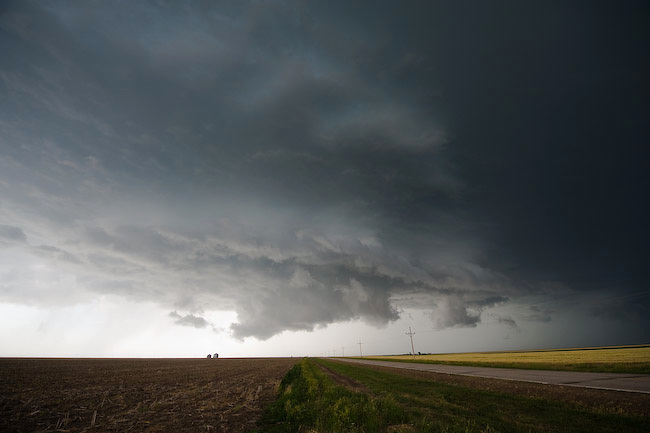
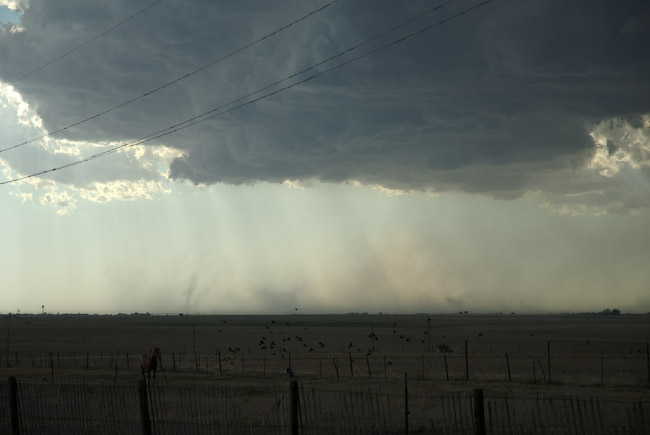
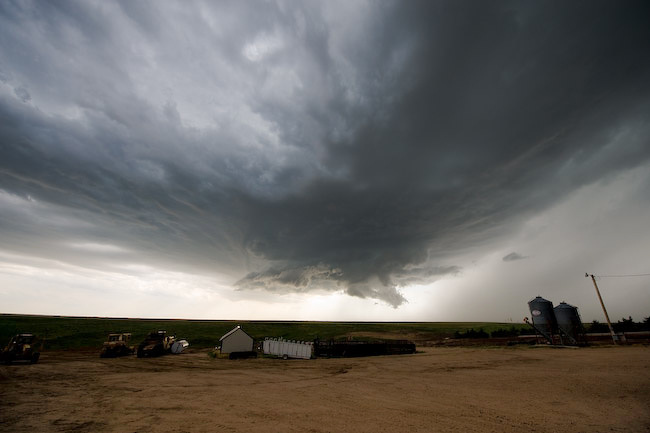
Vince and I started our chase trip on Wednesday, June 18th, by intercepting a briefly interesting marginal supercell thunderstorm that tracked from Seldon to Quinter (I finally chased a Quinter storm!) before losing the storm on muddy roads south of Quinter.  Our initial target was Syracuse to Goodland, KS or thereabout, and we were initially torn between two areas of potential development: 1) SW Nebraska to the south of Ogallala and 2) to the southwest of Leoti, KS where there was small scale convergence occurring at the nose of 100 degree air.  We opted for the northern play given the fact it wasn’t so hot up there and also 60+ dewpoints were more common.  

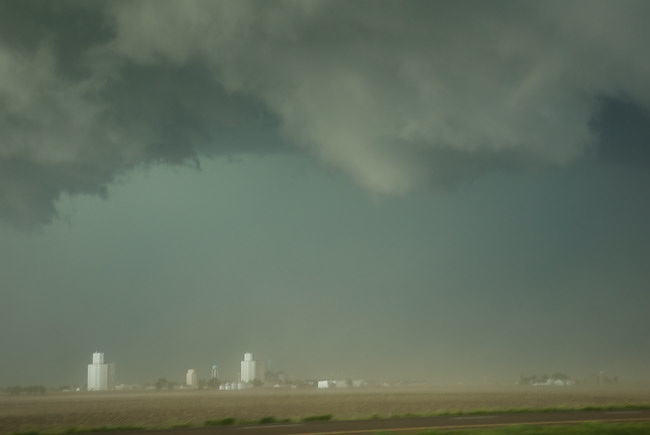
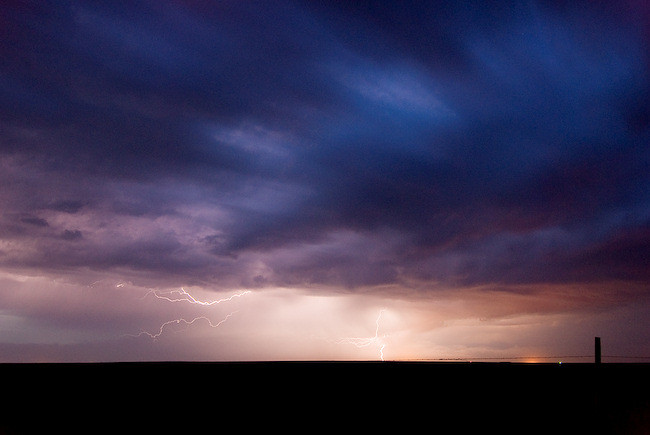
When we got to Colby, other storms were forming to the northwest of us, some of them tornado warned, but they were very high-based.  The tornado threat looked nil.  We knew that going in, but we decided to hang out about 15 N Colby to monitor this struggling activity to our northwest, east of Haigler NE as well as the progress of the larger storm that was moving southeast toward McCook.  I did capture one cloud-to-gloud lightning image from a high-based junk storm while we sat north of Colby.  We decided to head east on a dirt road toward Seldon.  On approach, we noticed a fairly beefy base develop just to our Southwest.  After nearly canning the whole chase since it looked bleak, we optioned to give one last attempt at this area of interest.  We dropped south from Seldon and this storm becan to take on interesting updraft structure with some supercell characteristics.  The problem was it was also undercut by strong north winds, at least from our vantage point due south of it, as we approached Grainfield.   Nevertheless, the structure was interesting and there was indeed some cloud base rotation at times.  We finally reached I-70 and drove east to Park and Quinter as the storm approached us.  Massive amounts of dust was limiting visibility off to the east and northeast, some of it quite interesting from a photographic standpoint with the small town of Park in the background to the northeast.  We finally reached Quinter when we thought it would be most beneficial to drop south on Castle Rock Road — not a bad option when roads are dry… but this was Gove County, KS, very limited on paved road options.  At any rate, other storms were rapidly developing to the southeast and southwest of us and we essentially became trapped.  

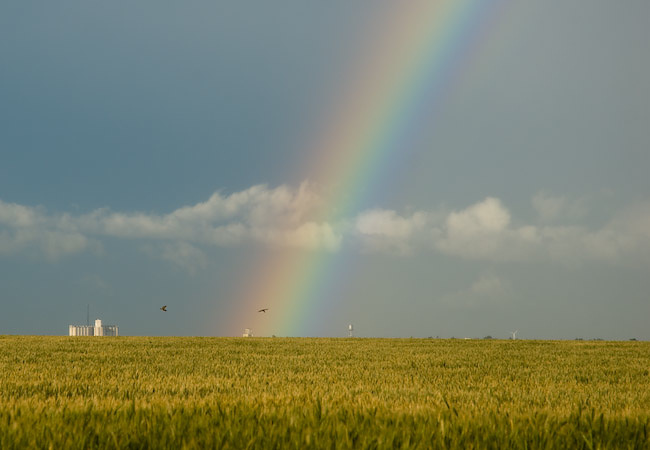
We decided that heading west on one of the dirt roads would be a better option given the limited amount of rain to the west.  What we didn’t count on, though, was the rear-flank downdraft portion of the storm biting us in the but with heavy rain and small hail.  That’s what happened, so we tried to manage the grated dirt roads the best we could, which actually worked out.  At least we weren’t that far from I-70 and Quinter should we have gotten stuck.  We drove north with only 4 miles to go on a rather hard, grated road, albeit very wet.  Well, the road eventually got soft on us as it approached the I-70 bridge 2 W Quinter.  Soft + wet = no good.  Vince managed to get through it though, but it took dire patience and quite a bit of sliding :)   We photographed a nice looking rainbow looking toward Quinter to the east behind the storm amidst our fun in the muck.  We finally hit hard ground and made it to Quinter in one piece, and with the storm to the southeast of us now and less interesting looking, we called it a chase.  


June 18, 2008

June Chase Trip 2008: Day 1 (KS-CO Border region)

Filed under: Chase Trip 2008,Storm Chasing — Mike U @ 10:34 am

The trip begins today!

Vince Miller is making his way to Dodge City as I type, and will be arriving shortly before noon.  It looks like we won’t have to go too far for Day 1.  In fact, it appears the first three days of our trip will be in the same general region of eastern CO and adjacent western KS.  For today, am expecting severe storms to develop in a north-south corridor from near Lamar to Wray, CO or so.  I think we’ll just head west on Highway 50 to Syracuse or thereabouts…and re-evaluate from there.  -Mike U

June 16, 2008

Chase Acct: June 15, 2008 (TX-OK Panhandle)

Filed under: Chase Accounts,Storm Chasing — Mike U @ 3:25 am

Sunday was another out-and-back trip.  I decided on yet another spontaneous chase after pseudo monitoring the situation while doing some other things during the afternoon.  It looked like there was a convergence max in the surface wind field near Beaver, OK, and with quite good deep layer shear and adequate moisture + instability (despite it being near 100 degrees to achieve this instability), I quickly gathered my gear and set out south to Englewood, KS (again, much like yesterday!).  There were several small storms developing to my southwest, and it took awhile for a supercell to be born out of this bunch.  Once I reached ~ 5 miles south of Laverne, I headed west on Hwy 270 to intercept the base of what would become the "Booker" supercell.  After heading west 20-25 miles, I dropped south to Darrouzett, TX, and this was really when I could get a good visual on the storm’s updraft.  I noted a big mass/column of dust near the updraft area.  I saw a storm chaser, Steve Miller, on the SpotterNetwork located very near this area, so I called him to find out what was up with this huge area of concentrated dust.  This area was showing diffuse rotation, but nothing really all that tornadic.

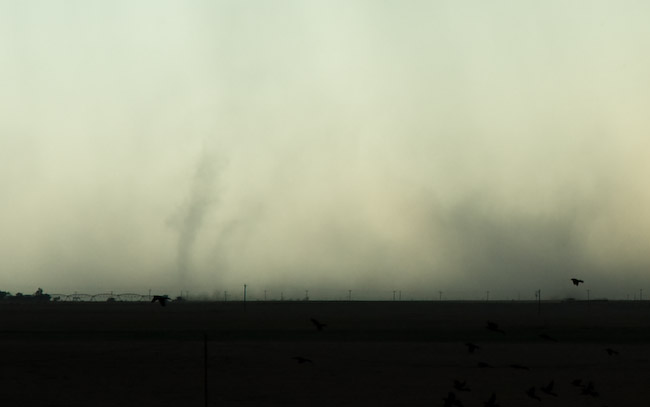
Just before I reached Booker, TX, I saw a very focused, translucent vortex tube in the dust.  For a very brief time, there was a miniature dusty "debris cloud" looking thing right below this translucent dust tube.  Thinking that this could have been a small tornado, I pulled over and took a couple photos.  Not sure exactly what to call this, but it could certainly be argued that it was a very brief, very small tornado.  This was the only tornadic-like action I observed in the dust, although the whole time, I remained well to the east and southeast of this activity — I was more interested in the storm structure for photography purposes.  This was a well-sculpted high-based supercell with rather meaty updraft structure — including a few wall clouds.  I followed this south on Hwy 23 south of Booker.  At times I had strong easterly inflow winds around 35 mph blowing into this storm.  Around 7:30 or so, the storm was beginning to show signs of decreasing in intensity.  I wasn’t all that interested in continuing south, since I had to be back to Dodge for my next midnight shift.  I blew off the storm and headed back north through Booker and Beaver up to Meade. 

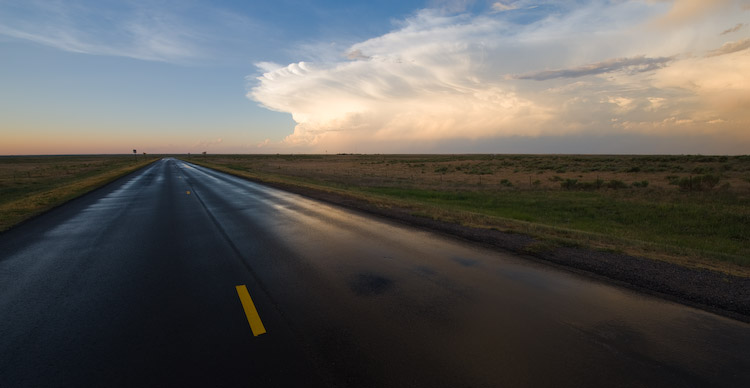
The drive on Hwy 23 in Meade County, KS was spectacular, as two storms to my northeast were on a collision course near Dodge City.  The "Golden Hour" photography light was just phenomenal — incredible contrast and color all around.  The Cb’s to the northeast were glowing orange-gold with rock-hard convection and a fantastic downstream anvil.  This was all more or less bonus material at this point, as my main goal at this point was just to get back home.  I stopped a few times to take advantage of this moment with the camera.  After the sun set, this storm finally met its demise, and I made it back to Dodge around 10:15pm or so.


June 15, 2008

Chase Acct: June 14, 2008 (Northwest OK)

Filed under: Chase Accounts,Storm Chasing — Mike U @ 3:39 am

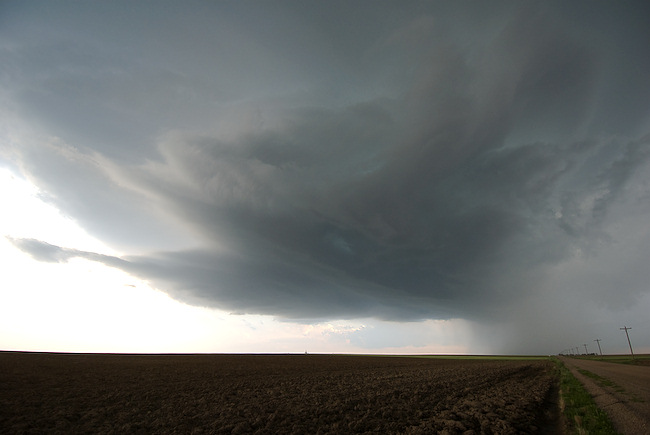
This was another one of those spontaneous chases.  I wasn’t exactly planning on chasing today, but I kept the opportunity open given the decent  west-northwest mid and upper level flow pattern combined the increase in 60s dewpoints northwest toward far northwestern Oklahoma.  Since I was due in to work at midnight, I was on a "leash", so I couldn’t really stray too awfully far from Dodge City.  That said, I decided to drive down toward Englewood, leaving around 4:30 or so.  I was just hoping for an isolated storm to form somewhere near Beaver County, OK just to the south and southeast of Liberal.  I was banking on storm motion being southeasterly given the mid level winds.  No storms formed in my target area.  By dumb luck, a storm had formed well to my south around the central Texas Panhandle.  This storm, a left-moving supercell, likely split off from initial convection that developed across the TX panhandle.  The end result was a storm that was moving northeast, instead of southeast.  This was good!  It was basically moving closer to me as I decided to inch farther south and east.  I took some initial photos around the Logan, OK area of the distant storm to my south-southwest.  I drove down to Follett and continued east as the main updraft of this storm was coming more into view. 

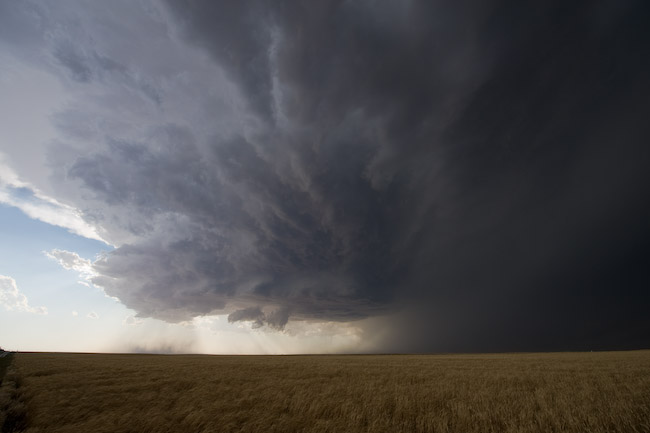
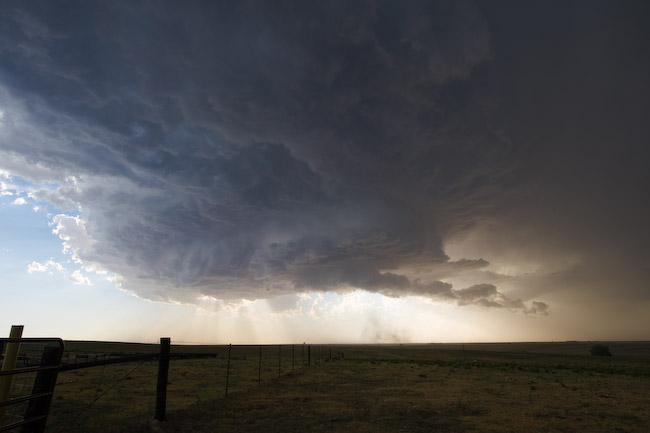
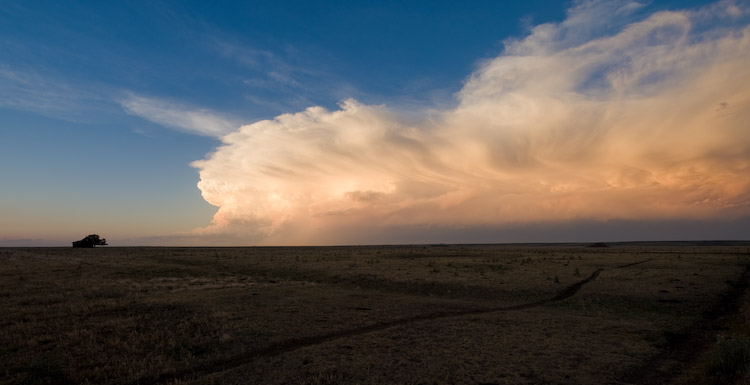
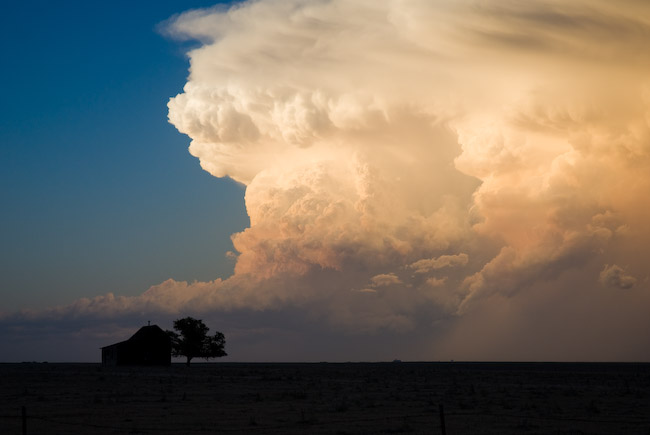
Left-moving supercells are somewhat rare and only thrive in environments that have a nearly straight line hodograph.  Usually left moving supercells have a hard northerly component, so storm relative boundary layer winds will have a northerly component to them.  Usually air is more stable the farther north you go unless a left-split storm is isolated and within a large warm, moist sector such that northerly storm relative winds are providing inflow into the storm with ample CAPE.  Well, this happened yesterday, and this supercell was fairly long-lived for a left-moving storm.  It produced a fairly long swath of very large hail of baseball size.  Photographically, this storm was awesome.  It was all by itself against blue sky, and the convection was very crisp with fantastic contrast.  It was exactly the type of storm I look to photograph.  All sorts of color and contrast.  This was the first good supercell I’ve photographed now with my new Nikon D3 + 14-24mm f/2.8 Nikon lens.  I looove that 14mm focal length on a full frame sensor!!  No 1.5 crop factor.  Wow is it wide.  I’m going to love this on my chase trip coming up (more details on that in a blog post soon!).  I followed this highly photogenic left-moving supercell from Gage to Woodward before calling it a chase.  There were moments with this storm where a decent looking wall cloud would develop with modest cloud base rotation (anticyclonic!).  Once I got to Woodward around 8:45pm or so, the storm was beginning to shrivel up croak.  It was excellent timing since I had to start my drive back to Dodge so I could get ready for work at midnight.  Below are a few photos:
 

June 14, 2008

Nikon D3 examples (part III)

Filed under: Photography — Mike U @ 12:00 pm

Incredible High ISO Performance!

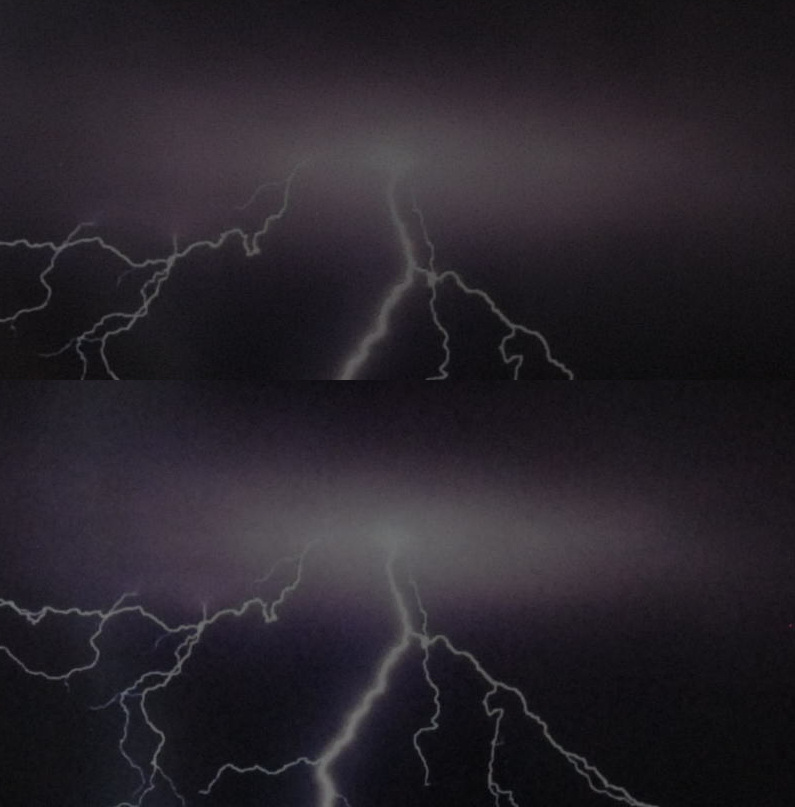
I did a poor man’s experiment to see how well very high ISO values of the D3 compared to my D200.  I was blown away.  The end result was that I was getting 640 ISO (from the D200) performance at around 3200 ISO!!  This is in the territory of 2 to upwards of 3 stops performance improvement in noise handling!  


In the example above, I photographed one of my large prints to use as a gauge for noise.  The top half of the image is shot with the D3 at an ISO setting of 2000.  In the bottom half, I shot with the D200 at an ISO setting of 640.  The noise on the D3 is quite a bit finer, which is easier to clean up.   More thorough reviews/tests of the D3 High ISO performance can be found below:

http://ishootshows.com/2008/01/07/impressions-on-the-nikon-d3-high-iso-performance/

http://www.kenrockwell.com/nikon/d3/vs-5d-180mm.htm 

June 13, 2008

Nikon D3 examples (part II)

Filed under: Photography — Mike U @ 5:22 pm

All about speed! 

Here is an example of two images of the same scene — The first is with the Nikon D3 and the 14-24mm f/2.8 lens at full wide angle.  The second image is with the Nikon D200 and the 12-24mm f/4 DX lens, also at full wide angle.  The test here is to demonstrate a similar shooting situation in a low lit storm environment and you couldn’t set up a tripod.  These are both handheld, both shot at the minimum possible exposure for handheld without getting destructive motion blur (usually the ‘rule of thumb’ for minimum hand-held shutter speed is the reciprocal of the focal length of the shot… i.e. for 14mm lens, about 1/15s exposure).  In the two shots, I tried to create the same exact exposure image with "reciprocal of the focal length" shutter speeds:

The two images below are 15% of the full size, embedded JPEG file from the RAW (using DCRaw to retrieve the JPEG)


Nikon D3 with Nikkor 14-24mm f/2.8 @ 14mm.  1/15s, f/2.8, ISO 400. 


Nikon D200 with Nikkor 12-24mm f/4 DX lens @ 12mm (18mm virtual focal length).  1/20s, f/4, ISO 1250


This is a 100% crop showing the more detail of the first image with the D3 + 14-24mm f/2.8.


This is a 100% crop showing the more detail of the second image with the D200 + 12-24mm f/4. 

Obviously, the first image is much cleaner thanks to the lower ISO.  This is due to the lens, not really the camera.  The next test in part III will be an ISO side-by-side comparison using the same lens on the D3 and D200.  This will give me an idea how far I can push the ISO out in the field to my liking.

Nikon D3 examples (part I)

Filed under: Photography — Mike U @ 4:26 pm

Below are some examples comparing Nikon D3 + Nikkor 14-24mm lens with Nikon D200 + Nikkor 12-24mm DX lens.  The Nikkor 12-24mm DX lens was built solely for Nikon DX SLR cameras (the smaller sensors).  This is a smaller lens, and it will only project to DX size sensors.  Now, a DX lens will still work on an FX digital camera, like the D3, but it severely limits the capability of using an FX camera.    

All the images below are 15% of the full size, embedded JPEG file from the RAW (using DCRaw to retrieve the JPEG) 


Nikon D3 with Nikkor 14-24mm f/2.8 lens @ 14mm.  1/640s, f/8, ISO 250, focal length 14mm


Nikon D200 with Nikkor 12-24mm f/4 DX lens @ 12mm.  1/640s, f/8, ISO 250, virtual focal length 12×1.5=18mm 


Nikon D3 with Nikkor 14-24mm f/2.8 lens @ 14mm, but this time I set the D3 to capture in DX sensor size, effectively turning the D3 into a ~6 megapixel camera.
1/640s, f/8, ISO 250, virtual focal length 14×1.5 = 21mm


Now, here is what a DX lens (the 12-24mm f/4 in this example) would look like when used on an FX camera (Nikon D3 in this example) in FX mode!

To spin this another way — You would need a ~9.2-16mm on a DX camera to replicate the angles of view that this 14-24mm lens gives on FX and film cameras.

New Expensive Toys! >> Nikon D3 & Nikkor 14-24mm f/2.8 lens

Filed under: Photography — Mike U @ 3:58 pm

I believe I am set for quite awhile with this new equipment I most recently purchased from B&H Photo. I wanted to get the best of the best in terms of photographic speed and optics for storm/landscape photography.  After doing my research, I believe I now own the very best Nikon currently has to offer in terms of super wide zoom + speed + optics.  The Nikon D3 is a tank, but man what an awesome piece of equipment.  Yes, it cost $5,000 dollars, but this camera is incredible.  After some of the reading I’ve done and some of my own very preliminary tests… I now have the freedom of shooting in the ISO 1000 to 2000 territory without having to worry about doing serious "noise reduction surgery" to the final images.  The Nikon D3 is a "full frame" sensor, which means no more 1.5x crop factor.  All digital SLR sensors, except for the high-end professional cameras, have ~ 24x16mm sensors.  Full-frame sensors on the new professional SLRs have sensors ~ 36x24mm.  Obviously, this is more surface area for a lens to project light to.  What this basically means is a lens labelled as, say 18mm focal length, will have no "crop factor", your image will truly be 18mm.  On a DX camera (I’ll use "DX" and "FX" which is Nikon’s lexicon for the smaller digital sensor vs. the full frame).  You’d have to multiply 18 by 1.5 to get the resultant "virtual" focal length, which in this case would be 27mm.  That is the first reason why I wanted to by the Nikon D3. 

The 2nd reason is speed in capturing light.  Allow me to explain.  All the big hoopla these days is how many megapixels a camera might have.  That’s all well and good, and yes, more megapixels = greater resolution and larger possible print sizes of images.  The problem is, if you cram too much resolution to a DX sensor, you introduce greater sensitivity to noise.  The size of a pixel of captured light on the sensor becomes smaller, thus you’d need greater exposure time to decrease the probability of introducing noise.  It’s a pretty simple concept really.  Okay, so to resolve this, professional line Nikon and Canon cameras introduced full-frame sensors so that they can increase the megapixel count without having serious noise problems.  The Nikon D3 is "only" a  12 mega-pixel camera, but it is a 12 megapixel camera on a FX sensor, which means a much greater surface area per pixel for light to hit.  This is a far less sensitive sensor to noise, which basically means you can set the ISO value (camera sensitivity) to values typically not thought of for serious amateurs/professionals, including myself!  This is why the D3 is a fast camera.  It captures light faster than any other dSLR on the market because of the design of the sensor — the fact it has a great sensor size/pixel ratio.  

There’s nothing like matching fast with fast.  My primary lens on the Nikon D3 will be the 14-24mm f/2.8 Nikkor. ($1600).  This lens is also a tank, given its very large aperture at f/2.8.  For storm photography, this is excellent.  Obviously, many storm images are taken in low light environment, whether it be the storm itself making it darker or the storm occurring late in the evening (although usually both!).  Many times as well, these storms are on the move, and there are many instances where there is little time to set up a tripod, so one must resort to hand-held images.  With handheld, you have to watch your shutter speed.  The faster the lens/camera combination, the greater your chances of not having to have to resort to low shutter speeds to capture an image while on the move.  A fast combination like this is also great for situations where one might wish to get long exposure images of storm structure after sunset, but do not want any motion blur (or very little).  There are situations where it’s great to have super long exposure motion blur of clouds, but there are other times when it is not, as well.  Super wide and super fast is what serious storm photographers need out in the field.  The next post will be some image examples comparing the D3 with my D200.

June 11, 2008

Chase Acct: June 10, 2008 (SW KS Bust!)

Filed under: Chase Accounts,Storm Chasing — Mike U @ 9:08 am

I’m not going to make this a very long post… but I’ll at least document this unfortunate chase.  Tuesday, June 10th was a day off work, and I was rather excited about the possibilities of playing with my new toy (more details in the next blog post!!) the very first day I got it.  All along, it appeared that it would be one of these marginal days for storm initiation, and if a storm went up, it would probably be all by itself, or at the very least, be some 200 miles away from the next storm.  My target for this happening was Southwest Kansas, probably not too far from Dodge City.  That isolated storm did indeed happen…. in North-Central Kansas!  Needless to say, I never made it up there, and all I could see was this tremendous back-sheared anvil way up on the northeast horizon.  This is a bust that is rather painful because I knew something like this would be extremely photogenic — tornado or not.  There were probably a handful of chasers on that storm, and only one SpotterNetwork car made it up there and that was Charles Edwards.  He actually blasted north from south of Dodge City early enough to get up there just in time before the last of the daylight.  Meanwhile, after the first Liberal storm initiated and struggled to survive — only ultimately to choke to death on the cap, I continued west in dire hope that another storm could form on the retreating dryline.   It never happened.  I ended the chase and drove back home, taking the long way… north to Garden City on US-83 then back east-southeast on 50.  I met up with Greg Stumpf and Steve Hodanish who were staying in Dodge — they also busted in the same area, so I wasn’t alone.  You win some, you lose a lot more ;-)
Here’s a StormLab screen capture from during the chase.  Note my position no where near that big red storm.  I’m at the bottom left between Garden City and Dodge City.  D’oh! 


June 5, 2008

Chase Acct: June 2, 2008 (WY-NE-CO Border)

Filed under: Chase Accounts,Storm Chasing — Mike U @ 10:27 am

June 2nd was the last of my 3-day mini-chase trip.  I started the day in Ogallala with Matt Crowther, Greg Brenneman, John Moore, and the "Original" Twister Sisters (Linda Kitchen and Kathy Velasquez).  Our target was west on I-80 near Sidney in anticipation of storms forming off the Laramie Range to the west.  There was a bunch of low clouds and light fog/drizzle to start the day across much of the Nebraska Panhandle, and this lingered through about midday before finally clearing off.  I parted ways with Matt’s group at Kimball, deciding to head west to the Wyoming border to monitor the first significant tower going up northeast of Cheyenne.  This first tower amounted to pretty much nothing.  I sat and waited awhile north of Pine Bluffs as weak showers/storms continued to develop around Cheyenne and points north…amounting to very little excitement.  The evening hours were waning fast and I was beginning to think this was going to be a bust.  I optioned back south closer to Pine Bluffs and continued to monitor, as I failed to give up hope.  I had a strong feeling decent storms would develop given the continued model forecast of strong convection developing in this area.

A supercell finally formed off to my southeast, and I bolted west on I-80 to a south option about 8 miles west of Pine Bluffs.  The storm showed some pretty good structure once I got far enough south.  I followed this storm east and south on unpaved county roads through the Pawnee National Grassland.  I stopped at a location east of Grover where I had a neat landscape with a few buttes in the landscape with the storm off in the distance to the north.  I managed to get a couple of cloud-to-cloud lightning images with the storm structure and the landscape with the Lightning Trigger.   I tried to get east of the main updraft area, but wasn’t having much luck.  A new severe storm was forming northwest of me, and I decided to wait for it for some more lightning images.  I photographed some long exposure structure + lightning for awhile in the southern part of the Pawnee National Grassland (north of Raymer).  I finally called it a chase at around 10pm mountain time, and headed south to Brush for the night.


« Newer PostsOlder Posts »

Powered by WordPress