My sudden mid-afternoon pessimism regarding the "cold-core" setup across south-central Kansas yesterday was realized. Storms did develop in the target area as mentioned in the forecast blog posts, but none of them were tornadic based on any reports. I say "based on any reports", because between 2205 and 2215 UTC (5:05 and 5:15pm), KICT WSR-88D revealed a very interesting, very small scale shear couplet with at least 3 volume scans of temporal continuity. The 2210 volume scan revealed what I believe is a TVS signature about 6 miles northwest of Goddard. It was only on one volume scan, and the entire shear signature was gone after 2215 as it evolved very quickly. Was there a brief tornado here? That brief TVS was only 11 miles from the KICT radar (with the center of the beam hitting an altitude of only ~ 500 feet above radar level at that range), and since the storm was so close to the KICT radar, the reflectivity looks unorganized and messy at best. A look from KDDC at that time revealed a 50dbz core extending up to about 20 thousand feet above this area. That brief TVS was interesting to say the least and is very convincing given temporal and even elevation angle continuity. Whatever happened, happened fast, probably less than a minute, and since there were no chasers out there that I know of west of Wichita at that time, if an event occurred there, it probably wasn’t observed. Who knows. I’m not aware of any damage reports from this location. See the 3-image composite below:

Storm chaser Dean Cosgrove sent me a couple links to images he captured of a well-defined funnel cloud from one of the storms along the occluded front in northeastern Pratt county near Preston at around 2135 UTC (4:35pm CDT). Below is one of the images.

Why weren’t storms more productive tornado wise? This is very difficult to answer with any degree of confidence since I haven’t done an in-depth post analysis of the event yet, however I think that southwesterly dry winds were converging too close to cooler northeasterly winds just to its north. There wasn’t a wide enough favorable airmass in between the dry southwest winds and cool northeast winds for storms to thrive long enough in order to take advantage of the rich ambient vorticity that was around. I think storms simply became undercut too quickly by cool northeast winds that resided immediately north of southwesterly surface winds. There really wasn’t much of a corridor of easterly or southeasterly winds (all that’s needed is about 20 to 40 mile wide corridor based on my experience from 26 October 2006 and 10 November 2008), and on 9 April there wasn’t even that, I don’t think. Again, I will have to look at the mesoscale data in order to help answer this. I also think the advancing cold front from the northwest was too much for the surface-based storms as well. Intense convection simply didn’t last that long. I also think this event lacked "converging boundaries". Both on 10 November 2008, and 26 October 2006, it was interesting to see on satellite imagery hours before the event occurred, the presence of cumulus cloud lines marking surface boundaries…which ultimately converged on one another in a constructive manner favoring tornadogenesis. I don’t think this occurred yesterday from what I saw in the data. I think this may have to do with the positioning/evolution of the 400mb PV anomaly. On 10 November and 26 October, the 400mb PV anomalies were very focused and even more mesoscale than yesterday. Yesterday’s 400mb PV anomaly was broader as it moved east, leading to a much broader surface response in the wind field. I don’t think the vertical vorticity axis was tightly concentrated over one specific area, but was rather strung out all along the occluded front without much room for storms to take advantage of before becoming overwhelmed by either chilly northwest surface winds or northeast surface winds. I’m thinking out loud here, but these are my early impressions on yesterday. These are very mesoscale details that make a huge difference in whether a "cold core" event is productive or not. This kind of detail can not be forecast with much ease at all. I more than likely would have busted yesterday had I chased, as I targetted Kingman. Congrats to Dean Cosgrove for at least intercepting something somewhat interesting from one of these short-lived storms.
Below is a visible satellite image as of 1930z. I am NOT a fan of all the mid level cloud that has developed over my target area in the zone of maximum surface vorticity at the nose of the west-northwest surge in dewpoints toward south-central KS. I’m not sure what to make of this. The nose of surface heating is displaced south of the moist axis by a fair distance, which is something I’m also not a fan of. I remember at this time of the day both on 10 November 2008 and 26 October 2006, there was NOT a large area of mid level cloud that spontaneously developed across my target with the best heating displaced south. I expected a surge in warm air northward toward Kingman-Wichita, but it is not happening. 19z obs show 70 at Alva, 71 at Medicine Lodge, and 73 at Wichita. The best warm surge is south of ICT across far north-central OK…thus am now thinking that the western limit of tornadic storms may be I-35 south of Wichita, perhaps. If I was in Kingman right now (like I probably would be at this time), I would seriously be considering heading southeast toward I-35 corridor down into Sumner County. This isn’t an easy virtual chase, and is not as "obvious" to me all of a sudden as I thought it may be like 10 November 2008 and 26 October 2006. No two "cold core" events are the same, that’s for sure, which is why it is a dangerous game to use comparisons to historical events like I do, LOL! History never repeats itself, but it does like to follow a rhythmic beat, which is why I think conceptual models and events of the past are helpful in forecasting. If this event busts, it isn’t the first time and certainly won’t be the last! That being said, it is still 20z at the time of this writing, so a lot can happen between now and 00z. In fact, I’m interested in the cyclonically rotating echoes on the DDC and ICT radars south of Pratt. There’s a 45 dewpoint in Pratt at 20z, so who knows. There could be a fluke brief tornado in Kiowa or Pratt counties since it’s so cold at 500mb.

Here is a 15z Surface plot with some subjective analysis of the temperature and dewpoint fields. Subjective surface vertical vorticity max is encircled. The short-term RUC and NAM suggest the surface vorticity max will strengthen and perhaps drift north through 21z…thus would expect moist advection to continue northwestward into the Wichita-Kingman area. If I was off work today, I would be driving toward Kingman right now (although I probably would have left at 11am!). Visible satellite, not shown, does reveal a very promising pristine sky in this area, so direct insolation will only aid in increasing low level lapse rates (decreasing static stability) to help spin-up the surface cyclone even more across south-central Kansas.

Early this morning, it appears the setup for possible tornadoes in south-central KS still looks pretty good. In fact, I think it looks really good! I just took a look at the 09z RUC 12-hour forecast for 21z, and I am pleased to see that it matches the NAM forecast pretty good in most of the fields supporting "cold-core" surface-based severe convection. The only difference is positioning of the fields. The 00z NAM forecast was a bit farther south from previous runs, however the 09z RUC is very similar to the previous NAM runs (farther north along Highway 54 corridor). Below are a few of the 09z RUC figures I put together to illustrate:
Figure 1. 12-hour forecast of surface wind and dewpoint from the 09z run of the RUC model. The region I am most interested is encircled dotted-black. I observed tornadoes both on 26 October 2006 and 10 November 2008 in this same area, conceptually speaking in terms of the surface wind and dewpoint fields. The western nose of the dewpoint/Theta-E field at the point of maximum surface vertical vorticity is the "place to be", in my opinion, for observing (a) tornado(es) given the tremendous source of vorticity and baroclinicity a storm has to work with. There will be a southeastward extension of this rich vertical vorticity along the occluded front, so as additional storms form southeast by late afternoon/early evening, there may be several storms producing tornadoes along the surface occluded front. I feel quite confident the occluded front will be very productive! 500mb Temperatures are also shown in this figure. Note how far east the -20C isotherm extends!

Figure 2. The 12-hour RUC is generating convection in the exact area I expected it to, which leads confidence in the forecast for (a) severe storm(s) with tornado prospects. This is even farther west than I was thinking yesterday, should this be a perfect prog. Model forecast CAPE is higher than I typically see for the true "cold-core" events, with the RUC suggesting near 1000 J/kg CAPE nosing as far west as Stafford County, KS!. Usually model CAPE doesn’t capture the true surface-based instability for these events very well. This could be a signal that today could be a very productive "cold-core" day.
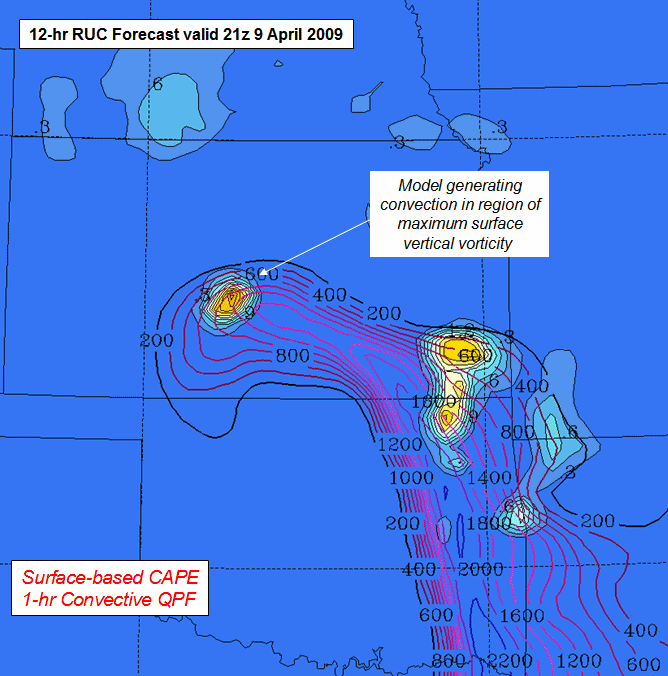
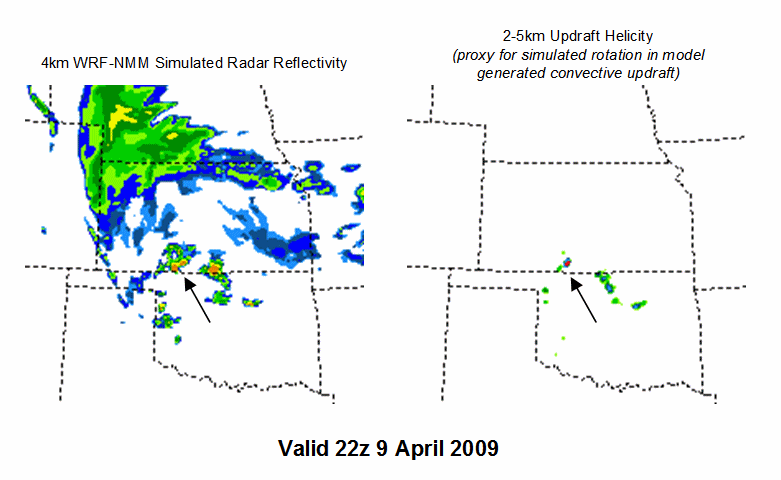
Figure 3. The 00z run of the 4km WRF-NMM is interesting. Hourly graphics of the simulated radar reflectivity show intense convection developing as far west as Coldwater-Medicine Lodge, KS at 22z… Wow! They may have to watch this closely at work (NWSFO Dodge City, KS) for our eastern counties from in the 21-22z time frame. I am scheduled to go into work at 21z!
So, the 64-thousand dollar question. Where would Mike target if he wasn’t at work this afternoon/evening?
Pratt, KS by Noon and watching the sky/visible satellite/observations/short-fuse composite very closely, with eyes set east (or east-northeast or east-southeast??) of Pratt for the 21-22z time frame!
I am intrigued by the setup for localized tornado event in south-central Kansas tomorrow. It is shaping up to be an event with similarities to 26 October 2006. I think (a) tornado(es) may occur farther west than the current Day 2 SPC (the 1st, 06z, issuance) outlook slight risk in a small corridor where upper 40s to lower 50s dewpoints will sneak west along the Highway 54 corridor from Wichita to Kingman. Surface vorticity will be maximized in this area due to the presence of a significant middle tropospheric potential vorticity (PV) anomaly. I like to look at 400mb for wind speed fields and related PV anomalies. It is just downstream of a 400mb PV anomaly where surface cyclogenesis (in the wind field) is maximized (dZeta/dt at the surface for you meteorologists out there!). I think if surface based storms form in this zone, it will take advantage of a tremendous source of vorticity in the low levels — both vertical vorticity and horizontal streamwise vorticity. Given the substantial ageostrophic motions present in the low levels in response to a small scale jet streak like this, there will be an enhancement in ambient vertical wind shear as well as the atmosphere tries to restore itself back to geostrophic balance. Okay, that’s some heavy meteorology, but that’s what is going on in these small space/time scales. Timing is critical. Like 10 November 2008 and 26 October 2006, the event occurred in a very short time window…usually centered around 21-22z. If the current NAM model holds, then the best area at the 21-22z time frame will be along the Highway 50 corridor somewhere in a Cheney Lake-Kingman-Wichita area. Below is a conceptual model I put together for an informal presentation back in January at a local AMS High Plains chapter meeting regarding these special events. What is very interesting about my conceptual model is that the area I drew this conceptual model — south central Kansas — is exactly where I think things may unfold tomorrow (very near the yellow area on the graphic!).

Below is the 33-hour forecast from the NAM valid 21z April 9th. The graphic is of 400mb wind speed and surface wind barbs. I annotated where the 400mb PV anomaly would be based on the wind speed field…as well as where the greatest vertical vorticity would end up being as well. This all seems to point to the Wichita area or points just west at 21z:

I am really intrigued by the meteorological setup across the far southwest Kansas/western OK Panhandle/extreme northeast NM corridor for later this afternoon. An intense, yet compact (important!) mid level potential vorticity (PV) anomaly will eject northeast out of New Mexico by midday and become centered across the area mentioned in the first sentence. This setup has some similarities to the 26 October 2006 setup, although probably not as intense. Nevertheless, there is the possibility for interesting low-topped, intense convection near the nose of the mid level vort max/PV anomaly where low level convergence/frontogenesis will be extremely favored. A narrow corridor of 45 to 50°F dewpoint air at the surface may extend northwest as far as Guymon, OK or even points west of there, sneaking into an area with ~ -21°C temps at 500mb. Since this isn’t all that far from Dodge, I will try to chase this setup and see what I can come up with. Just the thought of possibly seeing a brief "cold core" setup tornado in November is enough for me to get out the door, however small that probability may be. I look at the short-term RUC forecast and have visions of 26 October 2006 running in my mind. This would be a low CAPE event, with forecast CAPE on the order of 300 to 500 J/kg in a narrow corridor, but that is enough convective instability given the degree of focused, intense ascent from this small system at the nose of the mid-level PV anomaly. Below is a 9-hour RUC forecast:

Just changed over to sleet on the backside. Well it’s now 6am, after a night filled with freezing rain and occasional claps of thunder at 31-32°F. The surface cold front has just pushed through as our winds are now out of the north, so our temperature will now slowly fall throughout the day. As a result of the deeper cold air now, the warm layer aloft is being pinched off, thus we are changing over to sleet now in Dodge City. Garden City observation had light snow on the last observation. A very nebulous "comma head" of precipitation will produce mainly snow through midday across Southwest Kansas, although since this wave ejecting out is not a closed low per-say, there shouldn’t be a whole lot of significant "wrap-around" precipitation back in the cold air. Exactly 1.00" of precipitation has been recorded by the Dodge City ASOS by 6:10am this morning…. all of it in the form of freezing rain. I haven’t had the chance to see what has accumulated and been damaged from around town, but just by the looks of the healthy trees in my front yard and my neighbor’s, there’s at least 1/2 to 3/4" ice accumulation.
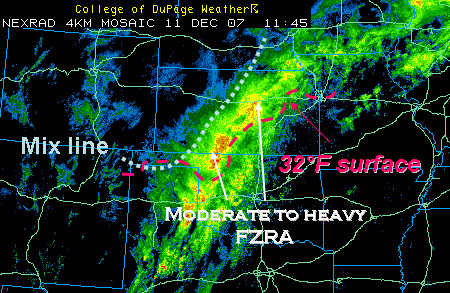
Thunderstorm with Freezing Rain! Round #2 has come in. The temperature is hovering between 31 and 32 right now. Here is the radar image with lightning overlay just a few moments ago:

A couple photos from the front yard:


0.50" of freezing rain since this afternoon (as of right now). Here in Dodge City, there is a very healthy coating of ice on everything now, the tree in my front yard is glistening against the street light with icicles aplenty. My driveway is pretty much solid ice as well. The street, though, it just wet still. We are sitting at about 30 or 31 degrees, so like I said earlier this afternoon, we have very slowly inched upward in temperature. A second round of fairly substantial precipitation is shown by the various versions of the RUC and also the GFS after midnight, which may yield another half inch of precipitation perhaps.

