0.50″ QPF. The 12z NAM, 14z RUC, and 13z HRRR all generate a half-inch of liquid equivalent precipitation. 18:1 SLR would be 9″ of snowfall. Stronger frontogenesis for a longer period of time is now expected across Southwest Kansas, especially between the Arkansas River and the Oklahoma border through this evening. Moderate snow is occurring now at my house with the northeast wind around 25 mph, gusting occasionally to 35 mph. Heavy snow is now developing to the northwest of Dodge City, and this will overspread Dodge by Noon. My own personal snowfall forecast is now 6 to 9″ for Dodge City. The office just upgraded Dodge to a Winter Storm Warning now for widespread 4-8″.

High snow-to-liquid ratios (SLR) being observed. Overnight, light to moderate snow accumulated 2 to 5 inches across northwest and north-central Kansas, southwest and south-central Nebraska. SLR of 18-25:1 are being reported with several 4 and 5 inch snow amounts up north with only about two-tenths of an inch of melted snow. Given the wind and the very “fluffy” nature of the snow, rain gauge catch is a big problem. Accuracy of SLR during these times are very poor… but that being said, I think at least 18 (if not low 20s) to 1″ liquid makes sense given the very deep dendritic growth zone layer of a couple hundred millibars. It’s snowing lightly as of 8:45am in Dodge City with what appears to be perhaps a tenth or two of accumulation.

The 12z RUC continues to be quite impressive with the simulated radar reflectivity and 700mb frontogenesis through the day across Southwest Kansas. I think we’ll easily see 5″ of snow in Dodge City, if not more, based on a high SLR from observations up north. New Local Storm Report came in at 8:37am of 4-6″ of snow from a spotter south of Collyer in Trego County (that’s in the Dodge City NWS forecast area). Wow.
12z RUC graphics follow. Last image is the RUC accumulated snowfall through Midnight tonight, showing 5″ in Dodge City:
Finally, some decent snow for Dodge City this season. About time. It looks like a 3 to 5″ snow event will affect Dodge City, KS and surrounding areas. The 08/00z runs of the NAM gives Dodge City about 0.55″ of QPF while the GFS and Canadian GEM offer around 0.30 to 0.40″ or so. What is interesting about this storm is that the thermodynamics in the lower-mid troposphere will be characterized by a very deep layer within the dendritic growth zone (-12 to -18°C). Saturation and lift through this deep growth zone layer will likely support liquid-to-snow ratios of 1:15 if not higher… to 1:18 or so. Therefore, 0.40″ QPF would yield 6 or 7 inches of snow. The official forecast for Dodge City is for 3-6″:
Tuesday: Snow likely before 9am, then snow and areas of blowing snow after 9am. High near 18. Wind chill values as low as -1. Breezy, with a east northeast wind between 22 and 24 mph. Chance of precipitation is 100%. New snow accumulation of 2 to 4 inches possible.
Tuesday Night: Snow and areas of blowing snow before 2am, then snow likely and areas of blowing snow between 2am and 5am, then areas of blowing snow and a chance of snow after 5am. Low around 0. Wind chill values as low as -19. Blustery, with a north northwest wind between 15 and 22 mph. Chance of precipitation is 100%. New snow accumulation of 1 to 2 inches possible.
Here is a surface map as of 06z (Midnight CST) showing the approaching arctic airmass ahead of the approaching upper low. Snow was already underway across western Nebraska and much of northeastern Colorado:

The following series of images show the 05z run of the 20km RUC model of 700mb Wind/Temperature/Heights along with Composite Reflectivity every three hours from 09z to 21z Tuesday. The last image is the RUC forecast snowfall accumulation total through 21z:
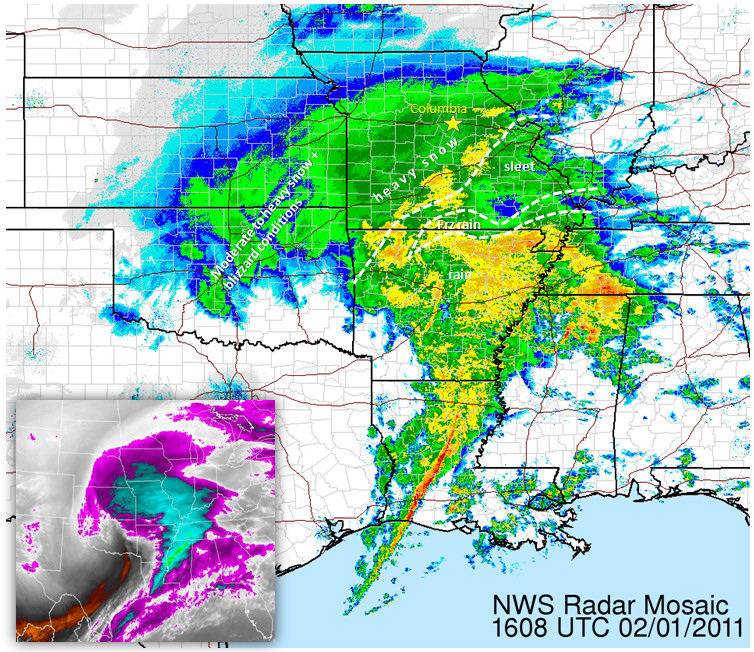
A classic mid-latitude cyclone maturing. I won’t type much on this post, just going to let the figure below do all the talking. Needless to say, the virtual snow chase target of Columbia, MO I picked late night Sunday night is looking very good as per the current conditions and all that heavy snow still to come. Blizzard or near-blizzard conditions are underway from Oklahoma City to Wichita to Emporia and things are getting bad in Kansas City. Winds will only increase in intensity in Kansas City.
Dodge City, you ask? -2F, -28F wind chill, very very light snow, and a total snowfall of about 0.3 to 0.5″ (that’s a guess looking out the window).

Extreme wind chills right now in western Kansas. Garden City’s 6am observation was -2°F with a 30 knot wind gusting to 38 knots. I’ve never seen such an observation this far south. That calculates to a -30°F wind chill! What’s just as amazing is it’s still colder upstream, so cold advection continues! Actualy air temperatures by midday will likely be several degrees below zero in Garden City and Dodge City on unprecedented arctic cold air advection.
Wow. Wow!
Here’s the 6:00am surface map. It will be a very very long time before I see another surface observation map like this again for western KS/northeast CO:

It’s a precipitation explosion! Well, the event has commenced. Our spectacular 1/2 to 1″ of forecast snow for Dodge City has started, but look at what’s going on southeast of here. Freezing rain and sleet is blossoming across North Texas and Oklahoma. There are a lot of Facebook status reports of heavy sleet with thunder and lightning around Oklahoma City and Tulsa. The warm layer aloft appears to be maximized around 775mb, per the RUC, and I used that to gage the freezing rain and sleet corridors. IDV is a wonderful tool to combine radar mosaic and RUC analysis fields. It’s the closest thing I can get to an AWIPS display. See the figure below:

A historic cold & windy day expected in Dodge City tomorrow! Well we may not be catching the snow end of this storm, but Southwest Kansas will bear the brunt of the cold + wind aspect of this storm. There is no missing out on this. A very rare combination of a 1052mb arctic high and a dynamic 1000mb low will be positioned perfectly such that Southwest Kansas will be right in the middle of the two. Arctic air is already in place, and as of the time of this writing, the temperature at Dodge City was 10°F (Fig. 1). The temperature will continue to steadily fall on 30 to 40 mph north winds all night and through the day Tuesday.
It should be noted that it is very rare to see temperatures hovering around 0 to 5°F throughout the day in Dodge City. It is even more rare to see 25 to 40 mph winds tied to these temperatures. This is a very anomalous cold event. Reaching wind chill advisory criteria (-15°F) is difficult enough as it is for Dodge City, let alone wind chill WARNING criteria (-25°F), given the new equation for Wind Chill Index. I have never seen the wind chill, with the new equation, reach colder than -20°F in Dodge City. The combination of wind and temperature should lead to wind chill index readings of -25°F on just sustained wind alone! In gusts, the wind chill will likely get as cold as -32°F!! See Figure 2 below showing the RUC forecast temperature and wind gusts for 15z (9am) tomorrow morning. Quite amazing.

Figure 1.

Figure 2.
A trace of snow in Dodge City this afternoon…heavier snow overnight. some low level snow showers developed this afternoon making the ground white in spots, but mainly what little snow has fallen is being blowing around on this afternoon’s 20-30mph north winds (Fig. 1). Temperatures have fallen into the upper teens, and even colder air is on the way. Winds will also increase overnight tonight as the low begins to take shape in Texas, along with the arctic high expanding across the northern High Plains. Winds will increase to 25-35 mph with frequent gusts above 40 mph by early Tuesday morning. Even if we get 1-2″ of snow, this will cause some problems. The latest GFS, NAM, and RUC all suggest a 1-3″ snowfall potential for Dodge City. Figure 2 shows the 19z run of the RUC model valid 10z (4am CST) tomorrow morning as the snow really ramps up across Oklahoma and southern Kansas. By 13z, the RUC shows about 1.5″ of snow accumulation in DDC. The HRRR has been showing the same kind of snowfall through that time as well. Tomorrow morning should prove to be nasty in Dodge City and all of southern KS for that matter. Figure 3 shows the Dodge City forecast with a high of 6°F tomorrow! Blizzard warnings have been issued from central/northeastern Oklahoma through much of Missouri and into Illinois (Fig. 4)

Figure 1.

Figure 2.

Figure 3.

Figure 4.
Watch out for the warm layer aloft! The potential for heavy sleet will wreck snow accumulations for some folks. I think the warm layer aloft, maximized around 800mb or so per the latest NAM, will extend as far northwest as my virtual chase target (Columbia, MO). I think south-central Missouri to Saint Louis may see enough of a warm layer aloft from 775 to 825mb to see sleet. In fact, far south central into southeast Missouri will likely experience quite an ice storm as maximum warm layer aloft temperatures may exceed +3°C. The series of images below shows this morning’s 12z simulated reflectivity from the 12km NAM. I also overlaid the 800mb critical temperatures, in 1°C intervals from -1C to +5C. In pink is the NAM model 31-34°F surface temperature range. Note the overlap of warm 800mb temperatures into the surface cold air with the precipitation moving across southeastern Missouri into far southern Illinois during the day Tuesday.
Series of 6-hr interval images from the this morning’s (12z Jan 31) 12km NAM model valid from 12z Tuesday 2/1 through 06z Wednesday 2/1
Virtual Winter Storm Chase Target……Columbia, MO. The global spectral model solutions have settled down enough to a point that it’s time to investigate some potential subsynoptic aspects of this storm and try to figure out where the best probability for 20 inches of snow will be. 20+ inches of snow from one synoptic storm in the central United States without any topographic or lake effect influence is rare. It takes the perfect combination of the golden three: 1) intense, deep tropospheric baroclinicity 2) very abundant Gulf of Mexico moisture, and 3) jet stream winds to manifest this baroclinic instability and moisture into one major-league, robust storm. See Figure 2 for the latest surface map showing the arctic air to the north and the Gulf of Mexico moisture ready to come back north. In essence, all great mid latitude cyclones, by nature, need to have all of these properties in order to produce such a large-scale, tremendous output of precipitation as can bee seen in Figure 1. Anyway, I wish I had the time off work to experience this one, seeing as we’ll miss out here in Dodge City, because there is a very good chance that a few locations will see 20-24″ of snow. The trick is trying to figure out where exactly that will occur. Model QPF fields give a nice clue, but QPF fields tend to be quite unstable run-to-run when it comes down to the details of figuring out where will be the greatest probability of the most snowfall. Cyclogenesis, cyclogenesis, cyclogenesis! It’s important to determine when the most mature phase of the storm will be (during what time frame is the 500-700mb lows deepening the most?). Ageostrophic motions in the atmosphere are most pronounced at times of cyclone deepening, when the atmosphere is really out of balance.
The GFS and the Canadian GEM models both suggest the most vigorous development during the day Tuesday with a 700mb low really deepening substantially by 00z Wednesday 2/2. It will be doing this over central/eastern Missouri. This is where I believe is the best probability for 20+ inches of snow. I believe this will extend from roughly Lake of the Ozarks to Columbia, MO to Bloomington, IL. Columbia is a nice middle ground, and it’s along Interstate 70, so thus the reason for choosing this as my virtual target. The GFS shows the 700mb Theta-E axis really maturing and bending back to the west into the cold air (Figure 3), with development of the inverted theta-e ridge (commonly known as the “TROWAL” in meteorological circles) by late in the day Tuesday. There will be 2 to 3+” per hour snowfall rates for a sustained period of time along the nose of the 700mb Theta-E ridge in the cold air. Upward vertical motion should be through the roof with all the sub-synoptic forcing for ascent and all the available moisture to work with.
Wind is another interesting facet of this system. Check out the forecast MSLP gradient in the 48-hr Canadian GEM model forecast!! (Figure 4). If that gradient does actually become realized, then blizzard conditions will exist. It’s shaping up to be a hell of a storm for eastern Oklahoma, pretty much all of Missouri, and Illinois.

Figure 1.

Figure 2.

Figure 3.

Figure 4.